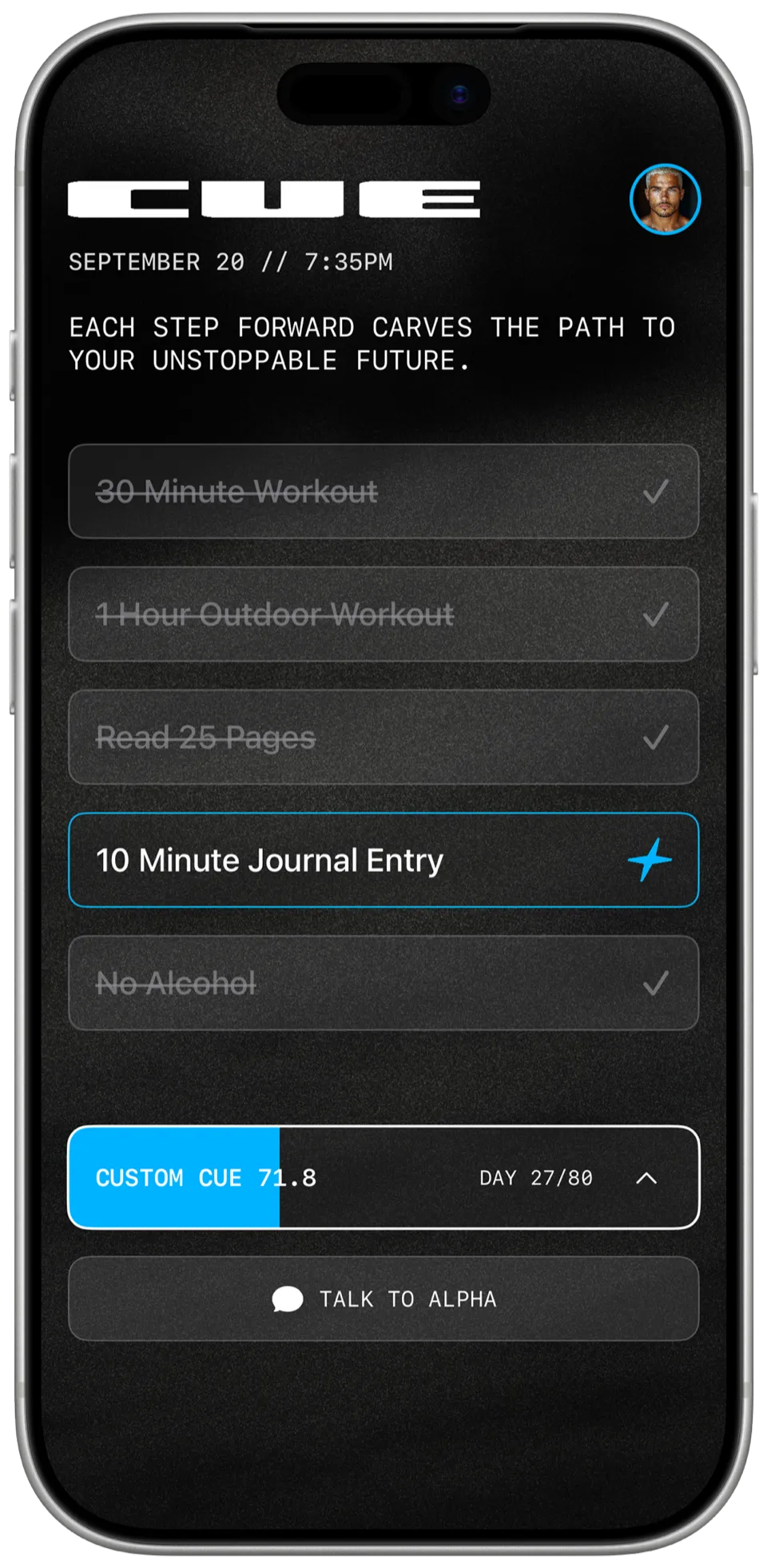
To hold yourself accountable, define one observable action, give it a deadline, choose proof that it happened, and decide your response to a miss before the day begins. Review the record daily. Accountability works when the promise cannot be quietly reinterpreted after the hard moment arrives.
You said you would do it. Nobody heard you. Nobody checked. By evening, the rule had changed from "finish the workout" to "I had a difficult day, so tomorrow makes more sense." The promise did not break all at once. It became negotiable.
Self-accountability closes that negotiation. Not with shame. With a written contract.
The four-part accountability contract
- Action: the exact behavior that counts.
- Deadline: when it must be complete.
- Proof: the record that shows it happened.
- Response: what you will do after a completion or a miss.
Accountability Starts With a Rule You Cannot Edit
"Work out more" is an intention. "Complete a 20-minute workout by 7 p.m. Monday, Wednesday, and Friday" is a rule.
The difference is not toughness. It is visibility. A clear rule can be completed, missed, or changed before the next commitment begins. A vague intention can be explained forever.
| Area | Vague promise | Accountable rule | Proof |
|---|---|---|---|
| Workout | Exercise this week. | Finish the planned 20-minute session by 7 p.m. Monday, Wednesday, and Friday. | Completed session recorded after the final set. |
| Study | Study tonight. | Answer problems 1–15 before 9 p.m. | Completed problems checked against the answer key. |
| Cleaning | Get the apartment together. | Run the ten-minute reset before dinner. | Timer complete and the named zone cleared. |
| Creative work | Make progress on the project. | Write 300 usable words before opening social media. | Word count and saved draft. |
Write the rule as if someone else has to judge it. If they would need to ask what "enough" means, the rule is not finished.
Choose Proof, Not a Story
Proof does not need to be public. It needs to be honest and proportionate to the action: a completed check-in, a saved file, a photo of the finished surface, a workout log, or the final page of a study block.
Proof protects the record from your mood. On a good day, you may want extra credit for doing more. On a bad day, you may want partial credit for almost starting. Neither changes the contract. The record answers one question: did the named action happen by the deadline?
Do not turn proof into surveillance. You do not need to photograph every private part of your life, publish your failures, or build a courtroom around a small habit. Use the least intrusive evidence that keeps the answer clear.
Decide the Response Before You Know the Result
A consequence is useful only when it improves the next decision. It should not injure you, humiliate you, drain money you need, or turn one miss into a week of punishment.
Useful responses include:
- After completion: record the day, close the task, and move on. Completion does not require a parade.
- After a miss: record it without editing the rule. Identify the failure point in one sentence.
- For a strict challenge: restart from Day 1 if that was the rule chosen before the challenge began.
- For a scheduled practice: run the next scheduled session; do not double the workload as punishment.
- After repeated misses: end the current commitment honestly, redesign the minimum, and start a new contract.
The hard part is not making a miss painful. The hard part is refusing to make the miss disappear. If your plan uses a restart, read how to restart without throwing away the work you already did.
Accountability Is Not Self-Punishment
Punishment asks, "How bad can I make myself feel for missing?" Accountability asks, "What does the record say, and what decision follows from it?" One creates drama. The other creates information.
A hard system can still be sane. The rule stays fixed during the commitment. The score stays honest. The response is carried out. But your food, sleep, safety, relationships, and basic needs are not collateral. You do not earn discipline by creating a second problem.
Use a response that restores the structure:
- Missed because the task was forgotten? Add a trigger and calendar block.
- Missed because the minimum took ninety minutes? Reduce the next contract before it starts.
- Missed because you chose something else? Record the choice without dressing it up.
- Missed because conditions became unsafe? Stop. A rule does not outrank reality.
This is demanding because it does not let you fake the score. It is controlled because the purpose is better follow-through, not suffering for its own sake.
Use This Daily Accountability Card
Copy this into a note, print it, or write it on paper. Complete the first five lines before the day starts. Complete the last two after the deadline.
The last line is not a journal entry. Keep it factual: "The gym bag was not packed," "I started after the deadline," or "The minimum was too large for a travel day." One fact can improve tomorrow. A page of self-criticism cannot.
Keep One Primary Contract
Five simultaneous promises do not create five times the accountability. They create five places to bargain. When everything is a priority, the easiest task gets checked and the important one waits.
Choose one primary contract for the current window. Other responsibilities still exist, but only one behavior gets the full daily proof system. Hold it for seven, thirty, or another fixed number of days. Finish the review before adding the next layer.
Use that contract to carry one real goal through the boring middle. If your own word has stopped feeling reliable, begin smaller with the seven-day self-trust promise.
If two actions must travel together, write them as one result. "Workout and stretch" is vague if either half can quietly disappear. "Complete the planned session and five-minute cooldown" is one scorable rule. Keep the contract small enough to read in one breath.
Run the Review Without Rewriting History
At the end of seven days, count completions and misses. Then review the system:
- Was the rule clear? If you argued with what counted, make it more observable.
- Was the minimum realistic? A minimum should survive an ordinary bad day, not an emergency.
- Was the deadline placed well? If the task always reached the most chaotic hour, move the next contract.
- Did proof create friction? Simplify the record without making it vague.
- Did the response help? Keep what improved the next action. Remove punishment that created avoidance.
Change the next contract. Do not change the old score. That is the line between review and excuse-making.
A sound challenge system makes this easier by setting the action, duration, and completion rule in advance. The daily card handles the close-up view; the challenge supplies the finish line.
What If Nobody Else Is Watching?
Good. Self-accountability should work in private. The goal is not to perform discipline for an audience. It is to build a record you believe because you know it is accurate.
Another person can still help when the work is easy to hide, the deadline matters, or repeated private attempts have failed. Ask for a specific check: "Text me Friday at 5 and ask whether the draft was sent." That is more useful than "keep me motivated."
Some problems need more than a productivity system. If the commitment involves addiction, disordered eating, dangerous exercise, severe mental-health symptoms, debt you cannot safely risk, or another situation where punishment could cause harm, do not build harsher stakes. Use qualified support and a safer plan.
Set One Contract Today
Choose one promise you keep moving. Write the action. Set the deadline. Name the proof. Decide the response. Then stop editing.
Accountability is not feeling guilty enough to act. It is making the truth visible before your mood gets a vote.
If you miss, record it. If the contract was badly designed, finish or end it honestly and build a better one. If the contract still fits, execute the next action. That is how self-discipline gets built from evidence instead of declarations.