Goals fail. Not because you lack motivation. Because goals are flexible. And flexibility kills accountability.
"I want to work out more." "I want to eat healthier." "I want to be more productive." These aren't goals. They're wishes. Vague. Unmeasurable. Easy to negotiate with.
Challenges are different. A challenge is fixed. Non-negotiable. Binary. You either complete it or you don't.
That's why challenge-based systems work when traditional goal-setting fails.
Why Goals Don't Work
Goals give you too much room to negotiate. You set a goal to work out three times a week. You hit two. You tell yourself that's close enough. Progress, right?
Wrong. That's not progress. That's compromise. And compromise becomes a pattern.
Soon, two becomes one. One becomes zero. The goal dies. You blame yourself for lacking discipline. But the problem wasn't discipline. The problem was the structure.
Goals are flexible by design. Challenges aren't.
The Challenge Framework
A challenge has three components: specific action, fixed duration, and binary tracking.
Specific action: "50 push-ups daily." Not "work out more." Not "get in shape." One clear, measurable action.
Fixed duration: 30 days. 60 days. 90 days. Pick a number and commit. No open-ended "I'll do this forever." A defined finish line.
Binary tracking: You either did it or you didn't. No partial credit. No "I almost did it." Binary. Complete or incomplete.
This structure removes negotiation. You can't debate whether 40 push-ups counts when the rule is 50. The challenge forces honesty.
Step 1: Define the Rule
Pick one action. One specific, measurable behavior you'll execute daily.
Bad rule: "Be more productive."
Good rule: "No social media before 6 PM for 30 days."
Bad rule: "Eat better."
Good rule: "No sugar for 30 days."
Bad rule: "Exercise more."
Good rule: "100 push-ups daily for 30 days."
The rule must be clear enough that a stranger could judge whether you completed it. No interpretation. No gray area.
Step 2: Set the Duration
30 days is the sweet spot for most challenges. Long enough to build a habit. Short enough to stay mentally committed.
60 days if you want to go deeper. 90 days if you're testing long-term lifestyle changes.
But never open-ended. The duration creates urgency. It turns an abstract goal into a concrete deadline.
"I'm going to meditate every day" feels overwhelming. "I'm going to meditate every day for 30 days" feels doable.
Step 3: Track Daily
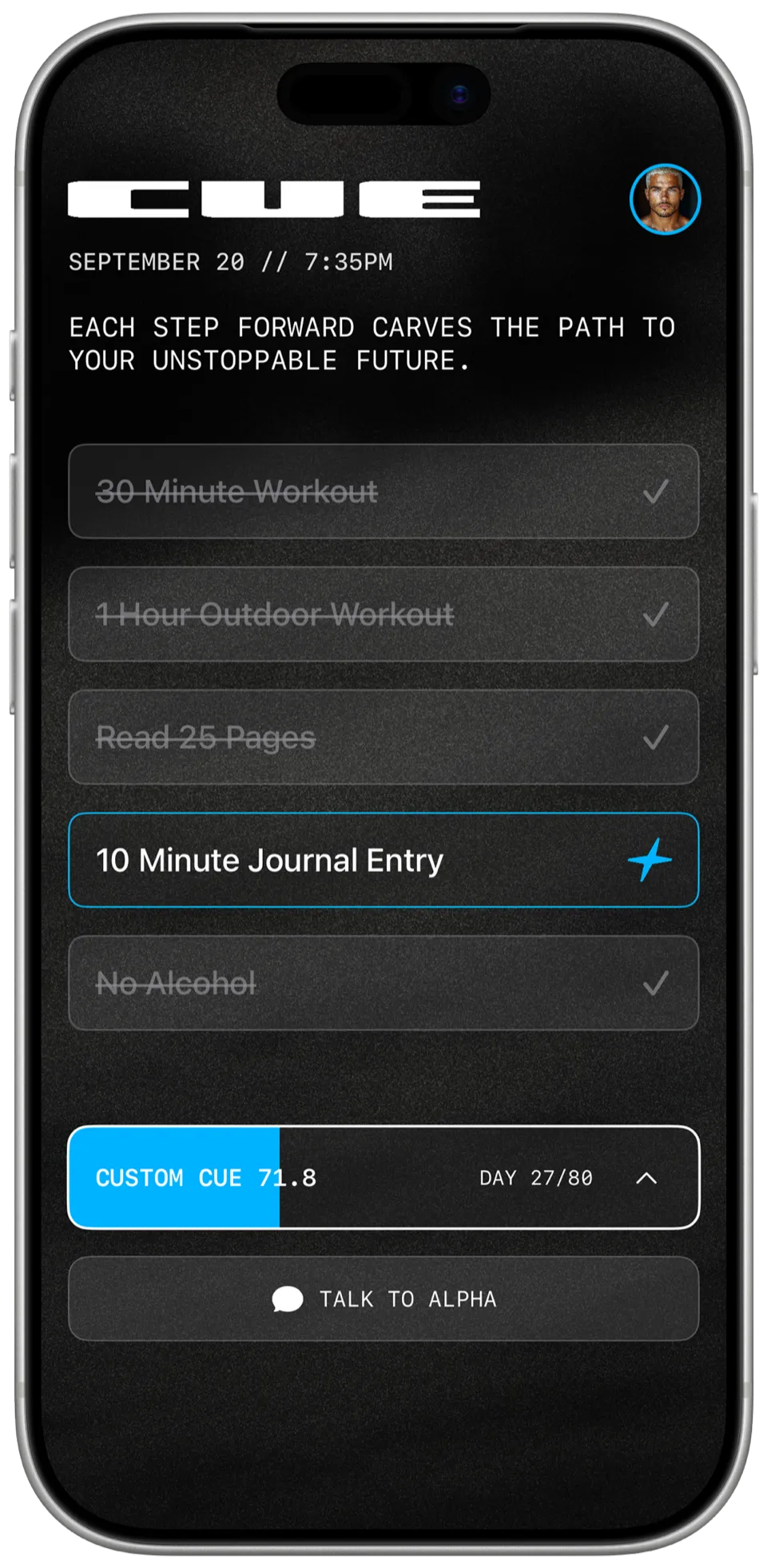
If you're not tracking, you're not accountable. Track every single day. Use Cue. Check off each completion.
The visual progress builds momentum. Seeing a 10-day streak motivates you to protect it. You don't want to break it.
Miss a day? The streak resets. That's not punishment. That's accountability.
The Restart Rule
This is the most important part of the system: miss a day, restart the challenge.
Not quit. Restart.
Most people miss a day and give up. "I failed. I'll try again next month." That's the all-or-nothing mindset that destroys progress.
Cue doesn't work that way. You miss a day? You restart from day 1. You don't quit the challenge. You reset it.
This does two things. First, it removes the shame of failure. You didn't fail. You just restarted. Second, it forces you to take the challenge seriously. You don't want to restart. So you execute.
Why Fixed Challenges Work Better Than Flexible Goals
Flexible goals let you negotiate. "I'll work out tomorrow instead." "I'll make it up next week." "Close enough."
Fixed challenges don't. The rule is the rule. 50 push-ups. Not 45. Not tomorrow. Today. Now.
That rigidity feels uncomfortable at first. But it's the rigidity that builds discipline. You learn to execute regardless of how you feel.
That's the skill. Not motivation. Execution without negotiation.
Common Mistakes
Mistake 1: Starting too big. 100 push-ups sounds impressive. But if you can't do 20, you'll fail on day 1. Start with something you can actually complete. Scale later.
Mistake 2: Multiple challenges at once. One challenge. Master it. Then add another. Don't try to fix your entire life in 30 days.
Mistake 3: Vague rules. "Be more disciplined" is not a challenge. "Wake up at 6 AM daily for 30 days" is.
Mistake 4: Quitting after a restart. Restarting is part of the system. It's not failure. It's recalibration. Keep going.
How Cue Works
Cue is built around this framework. You set a challenge. You define the action, the duration, and the rule. Then you execute.
Every day, you mark it complete or incomplete. The app tracks your streak. Miss a day? The challenge resets. But you don't quit. You restart.
This structure removes flexibility. It forces accountability. And over time, it builds discipline.
Most apps let you adjust your goals when they get hard. Cue doesn't. The challenge is fixed. Your job is to execute.
Start Your First Challenge
Pick one action. Something specific. Something measurable. Something you can do daily.
Need a clean first rule? The 30-day journaling challenge uses one five-minute entry, one honest question, and one next move every day.
Set the duration. 30 days.
Track it in Cue. Every single day. Check it off. Build the streak.
Miss a day? Restart. Don't quit. Restart.
30 days from now, you'll have proof that you can commit to something and follow through. That's how discipline is built.
If you need a challenge worth running, start with these 21 monthly goals with clear finish lines. If your choice is 75 Soft, review the four tasks and complete 75-day timing before you begin.