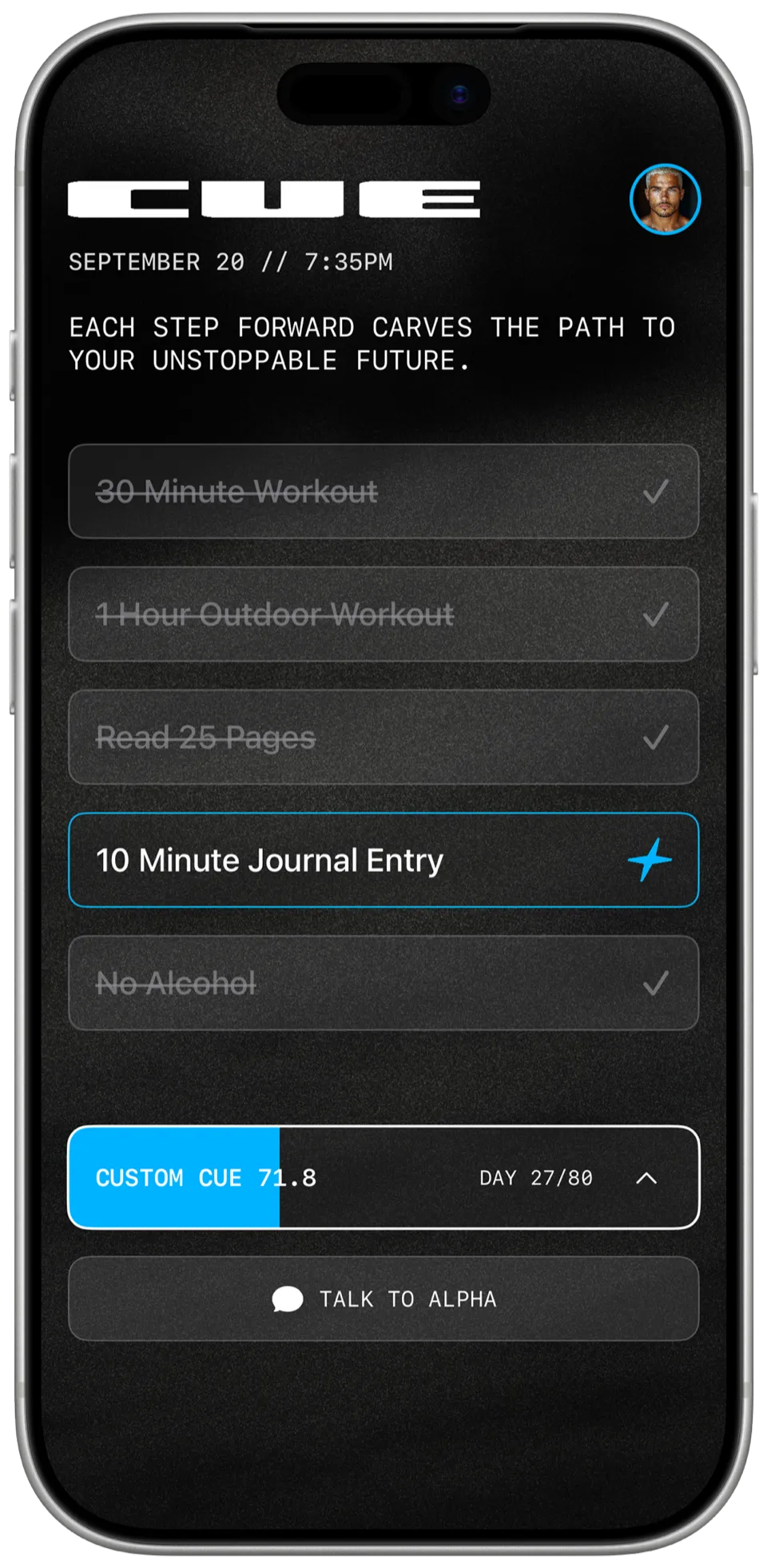
To trust yourself again, make one small promise that is completely under your control and keep it every day for a fixed period. Make the rule observable. Record the result honestly. Self-trust returns when your actions become reliable enough that your own word starts meaning something again.
You do not rebuild trust with a speech.
You rebuild it the same way trust is built anywhere else: a promise is made, reality applies pressure, and the promise survives.
If you have spent months saying tomorrow and waking up inside the same pattern, another giant declaration will not help. You have heard yourself declare enough. Use a real accountability rule instead.
Now you need evidence.
Stop Asking Confidence to Go First
People wait to feel certain before they act. They want the old confidence back before they apply, train, leave, begin, or speak.
But confidence built only in your head has nothing to stand on.
Let the action go first. Confidence can catch up.
This does not mean pretending fear is gone. It means refusing to make fear the project manager. You choose a small promise, define exactly what keeping it looks like, and complete it while your doubts keep talking.
Choose a Promise Too Clear to Manipulate
“Be better” is not a promise. “Try harder” is not a promise. “Work on myself” can mean anything by nightfall.
Choose an action another person could score without reading your mood:
- Walk outside for 20 minutes before 8 p.m.
- Read ten pages before opening social media at night.
- Write one honest journal entry before bed.
- Complete the planned workout on Monday, Wednesday, and Friday.
- Spend 25 uninterrupted minutes on the work you keep avoiding.
The action should matter. It should also fit inside your actual life. A promise designed to impress you is often too large to teach you anything except how to break another promise.
For the next seven days, I will [specific action] by [time]. It counts only when [visible finish]. I will record the truth immediately after.
Make It Small, but Do Not Make It Fake
Small is not the same as meaningless.
Drinking a random glass of water at noon will not rebuild trust if the promise you keep avoiding is sending the application. The action must touch the part of your life where your word has gone soft.
Reduce the size, not the honesty.
If writing the proposal feels impossible, promise 20 focused minutes on the proposal. If returning to the gym feels too large, promise one scheduled session with a defined routine. If your room has become a monument to delay, promise one ten-minute zone reset.
The goal is to create a promise you can keep without pretending it is effortless.
Your Word Has to Survive an Ordinary Bad Day
Keeping a promise when you are energized is useful. Keeping it when the day is inconvenient changes the evidence.
The real test is not disaster. It is the ordinary bad day: you slept poorly, work ran late, the couch is warm, and nobody will know.
That is where self-trust is priced.
Decide in advance what you will do. Put the shoes by the door. Block the time. Remove the app. Open the document. Make the first correct action easier to reach than the first excuse.
You do not need to win an argument with yourself. Build the evening so there is less argument available.
Keep Score Without Turning It Into a Trial
Record complete or incomplete. No creative accounting.
Do not add bonus points because the intention was sincere. Do not erase the day because you feel ashamed. The record exists to tell the truth, not to deliver a verdict on your worth.
This matters because both dishonesty and self-punishment destroy the lesson. Dishonesty says your word can still be edited. Punishment says a missed action means something is wrong with you.
Neither is useful.
The useful response is exact: “I said I would do this. I did not. Here is what happened. Here is the rule for what comes next.”
When You Break the Promise
If you miss, do not immediately make a larger promise to compensate. That is how the cycle restarts.
Look at the failure without drama.
Was the action unclear? Was the time unrealistic? Did you depend on a cue that never happened? Did you knowingly choose something else? Is the commitment still safe and worth keeping?
Fix the system where it broke. Then follow the restart rule you chose at the beginning. Cue challenges return to Day 1 after a miss because the contract is consecutive completion. A different personal plan may use a different rule. What matters is choosing it before the result is known.
If you need the reset, use this guide to restart without turning the miss into a shame cycle.
Self-Trust Does Not Mean Blindly Obeying an Old Decision
You are allowed to change your mind.
Trusting yourself does not mean finishing an unsafe workout, staying in a destructive situation, or honoring a goal that no longer fits reality. It means making the change consciously instead of quietly betraying the agreement.
Pause. State what changed. End or revise the commitment before making the next one.
A boundary can be an act of self-trust. So can asking for help. Discipline is not automatic obedience to every decision your past self made.
Seven Days Is Evidence. Keep Building.
After seven days, do not rush to add six more habits.
Look at the record. Did you keep the promise? Did the rule survive the difficult hour? Did you learn where the setup failed?
If the promise held, keep it or raise the demand slightly. If it broke, correct the design and begin again. You are not trying to create a perfect week. You are teaching your own word to carry weight.
If you need a clean next test, use the 30-day journaling challenge to pair one honest entry with one daily action. If the problem is choosing the action at all, close the loop with the decision-deadline protocol.
Self-trust is quiet.
It is knowing that when you say you will do the next hard thing, there is evidence behind the sentence. Then you can use that evidence to finish something larger.