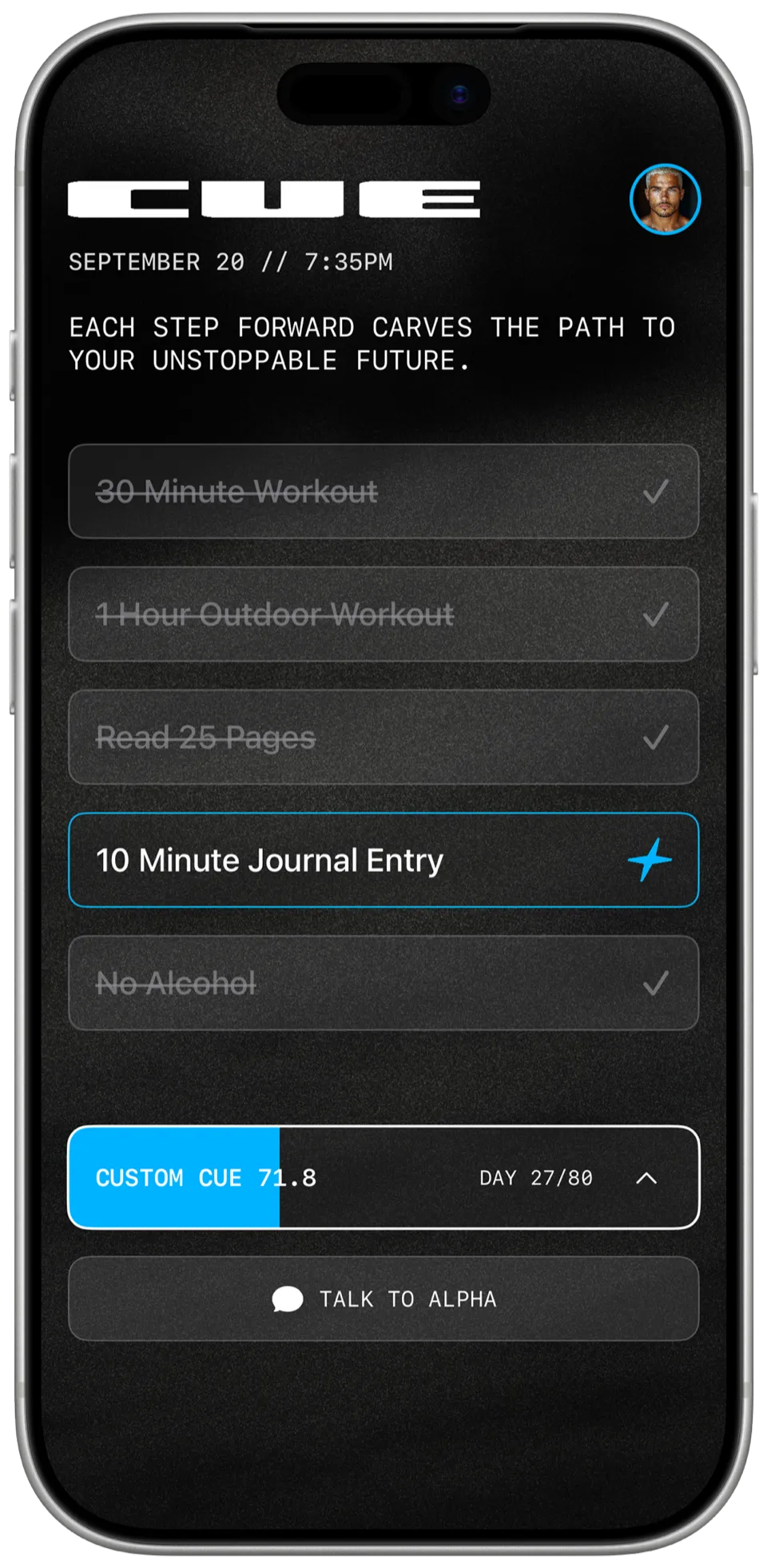
For this 30-day journaling challenge, write one honest entry every day for at least five minutes. Date the page, answer one useful question, and end with one action or decision. If you miss a day, restart at Day 1. The goal is not beautiful writing. It is 30 consecutive days of telling yourself the truth.
Your journal does not need to become a leather-bound performance.
You do not need perfect handwriting, a sunrise routine, a fountain pen, or three pages of insight before the world wakes up.
You need a page. A time. A rule. And enough honesty to write the sentence you keep avoiding.
The Challenge Is Simple
For 30 consecutive days, sit down and write one entry.
Set a five-minute minimum. You may continue longer, but extra writing does not create credit for tomorrow. Each day requires its own entry.
The entry counts when it includes three things:
- The date.
- An honest answer to one prompt or question.
- One next action, decision, or deliberate release.
That is the whole contract.
- Write every day for at least five uninterrupted minutes.
- Date every entry.
- Answer one real question. No filler required.
- End with one next move—or write that no action is needed.
- Miss once and restart at Day 1.
Why End With a Next Move?
Reflection can become another hiding place. The last line forces the page to meet the same standard as a finish-line plan: what happens next?
You can analyze the same frustration for six pages and still avoid the email. You can describe the fear perfectly and never make the decision. You can understand the pattern without interrupting it.
The last line gives the entry an edge.
“Tomorrow I will ask for the deadline in writing.”
“I am not acting on this yet. I will review it Friday.”
“I cannot control their answer, so I am releasing the argument tonight.”
Not every feeling needs a task. But every entry should finish somewhere.
Do Not Write for an Imaginary Audience
The fastest way to ruin a journal is to start auditioning.
You make the sentences wise. Remove the contradiction. Write the version of the day that would make sense if somebody found it later.
That may produce better prose. It produces worse evidence.
Write the first answer that makes you slightly uncomfortable. The resentment. The relief. The fact that you do not want the goal you keep announcing. The fact that you do want it and are terrified of the work.
You are not required to be fair in the first sentence. You are required to keep going until the entry becomes more accurate.
Use One Prompt Until It Stops Working
You do not need 30 decorative prompts.
You need a few questions sharp enough to open the day. Rotate these when the page goes blank:
If the same complaint keeps filling the page without changing anything, run it through the request, action, or release rule.
If one question keeps producing useful answers, keep it. Novelty is not the goal. Contact is.
When You Have Nothing to Say
Write that.
“I do not want to write because…”
Then finish the sentence ten times if necessary.
A blank mind often means one of three things: you are tired, you are performing, or the real subject is standing behind a safer one. The five-minute rule gives the page enough time to get past the first defense.
If nothing dramatic appears, that is fine. Record the day accurately. What took your attention? What did you complete? What remains open? What is tomorrow’s first move?
An ordinary honest entry counts.
The Four Parts of the 30 Days
Days 1–7: Show up without improving the ritual
Use the same notebook or document, the same general time, and the five-minute minimum. Do not shop for a better system. Your only job is to make the entry exist.
Days 8–14: Notice the repeated sentence
Look for the complaint, fear, name, or decision that keeps returning. Do not solve it immediately. Name the repetition. Patterns become harder to deny when they are written in your own words seven times.
Days 15–21: Make the page produce action
Tighten the last line. Choose one action you can complete within 24 hours. The journal should begin changing the day outside the journal.
Days 22–30: Decide what deserves to continue
Review the record. Which problem needs a conversation? Which goal needs a contract? Which pattern needs outside support? Which worry has received enough attention?
On Day 30, write a one-page verdict: what became clearer, what changed, and what you will do next. That record can become the evidence behind a larger effort to trust your own word again.
Protect the Privacy of the Work
Choose a format you can use honestly.
If a paper journal may be read without permission, use a secure digital option or keep the writing somewhere protected. Do not include another person’s sensitive information casually. You can tell the truth about your experience without building a permanent file on everybody around you.
Journaling can support reflection, but it is not a replacement for mental-health care, crisis support, or qualified advice. If writing repeatedly intensifies distress, stop the challenge and get the support that fits the situation. A challenge is never more important than your safety.
If You Miss, Restart Clean
No backdating.
No double entry tomorrow. No paragraph about how yesterday basically counted because you thought about writing in the shower.
Record the miss. Fix the setup. Restart at Day 1 without turning it into a shame cycle.
The pages you already wrote still matter. The counter resets because the contract was 30 consecutive days. That is not punishment. It is an honest description of what happened.
Open the Page Tonight
Write the date.
Set five minutes.
Answer this: What am I pretending not to know?
End with one move.
Then come back tomorrow and tell the truth again.