You want discipline. You've tried building it. You failed.
Now you're wondering if some people are just naturally disciplined and you're not. Spoiler: they're not. Nobody starts with discipline. You build it.
But most people try to build it the wrong way. They rely on motivation. They start big. They burn out fast. Then they blame themselves for lacking willpower.
Discipline isn't a personality trait. It's a skill. And like any skill, you can learn it. Here's how.
The Discipline Myth
Most people think discipline means waking up at 5 AM, training hard, eating clean, and staying focused all day without struggle. They look at disciplined people and assume it's easy for them.
It's not.
Disciplined people don't have special genetics. They don't wake up energized and excited to do hard things. They just have a system that works when they don't feel like it.
That's the key. Discipline isn't about feeling motivated. It's about executing regardless of how you feel.
Why Motivation Fails
Motivation is a terrible foundation for discipline. It's unstable. It comes and goes. One day you're fired up. The next day you're drained.
If you rely on motivation, you'll only act when you feel like it. And feelings are unreliable.
Discipline is the opposite. It's a system that removes feelings from the equation. You don't ask yourself "Do I feel like doing this?" You just do it. Because that's the rule.
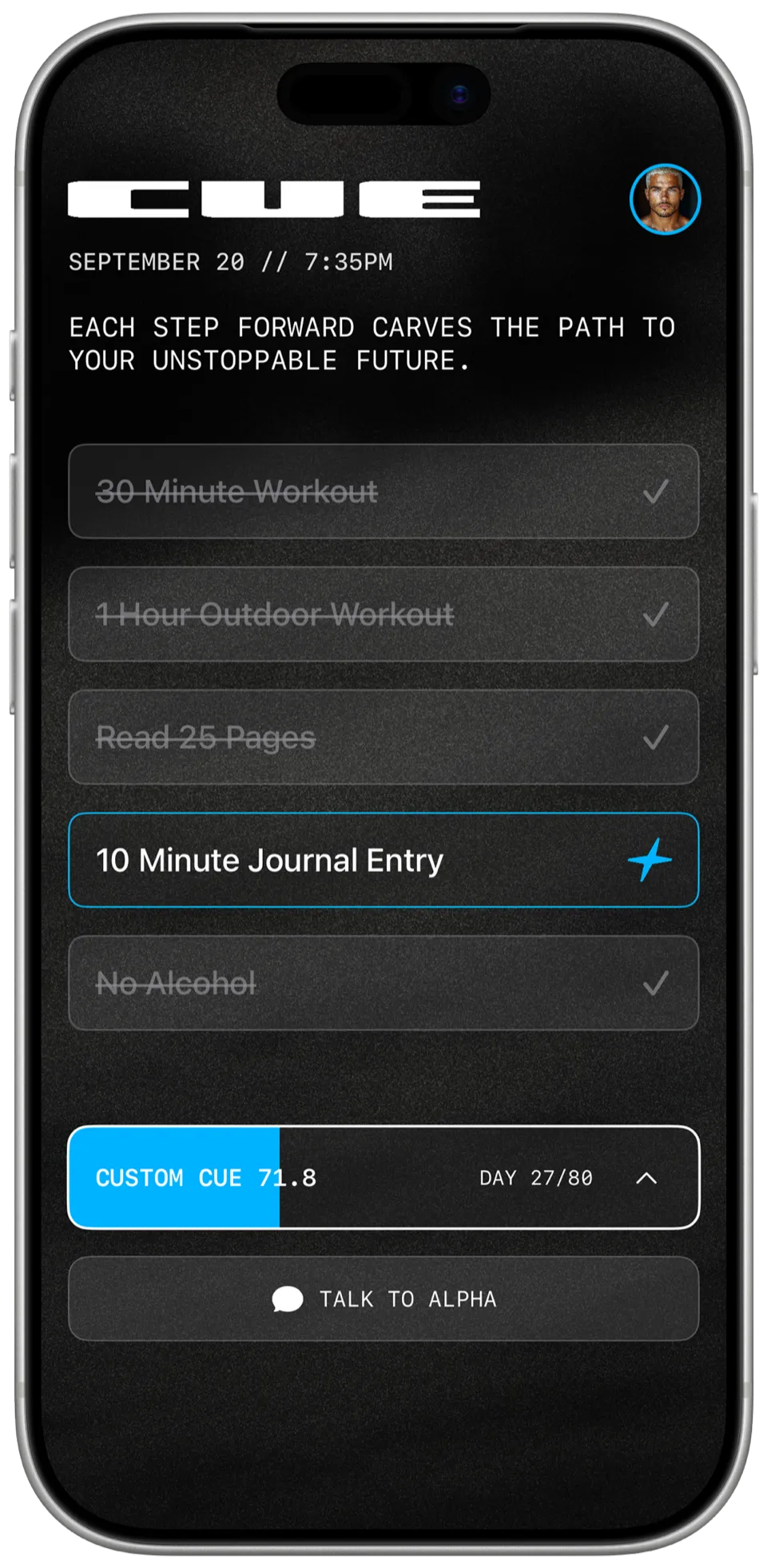
Cue is built on this principle. You set a challenge. You commit to a fixed number of days. You execute. No flexibility. No "I'll do it when I feel motivated." You either complete the day or restart.
That's how discipline is built. Through repetition. Through execution without negotiation.
Step 1: Start With One Rule
Don't try to fix your entire life at once. Most people fail because they set 10 goals and burn out in a week.
Start with one rule. One non-negotiable action you'll take every day for 30 days.
Examples:
- No phone for the first hour after waking up.
- 10 push-ups before breakfast.
- Read for 15 minutes before bed.
- Cold shower every morning.
- Journal for 5 minutes before sleep.
Pick one. Lock it in. Execute daily.
Step 2: Make It Binary
Discipline requires clarity. You need to know if you did it or not. No gray area. No "I kind of did it."
Bad rule: "Eat healthier."
Good rule: "No sugar for 30 days."
Bad rule: "Work out more."
Good rule: "50 push-ups daily for 30 days."
Bad rule: "Be more productive."
Good rule: "No social media before 6 PM for 30 days."
Make the rule specific. Make it measurable. Make it binary.
Step 3: Commit to a Fixed Duration
Open-ended goals don't work. "I'm going to work out every day" sounds good, but there's no endpoint. No finish line. So you quit when it gets hard.
Set a fixed challenge: 30 days. 60 days. 90 days. Pick a number and commit.
Knowing the challenge has an end makes it mentally manageable. You're not committing forever. You're committing to a defined period. That's powerful.
Step 4: Track Daily
You can't build discipline if you're not tracking. You need proof. You need evidence that you're executing.
Use Cue to track your daily completion. Check off every day. Miss a day? Restart the challenge. That's the system.
The restart rule is critical. It removes the "I'll make it up tomorrow" excuse. You either do it today or you restart. That clarity builds accountability.
Step 5: Eliminate Decision Fatigue
The more decisions you make, the weaker your discipline becomes. Your brain has a limited capacity for willpower. Every decision drains it.
Remove decisions. Automate your actions.
Don't wake up and ask "Should I work out today?" Decide once. Then execute daily without thinking.
Don't debate whether to eat the cookie. Set the rule: no sugar for 30 days. The decision is already made.
Discipline isn't built through constant negotiation. It's built through removing negotiation entirely.
Step 6: Execute Without Emotion
You will not feel like doing it. Accept that now.
Some days you'll wake up motivated. Most days you won't. Discipline means executing on the days you don't feel like it.
That's where growth happens. Not on the days you're fired up. On the days you're tired, unmotivated, and distracted — and you do it anyway.
Don't wait for the right mood. Execute regardless.
Step 7: Embrace the Restart
You will miss days. That's expected. The question is: what happens next?
Most people miss a day and quit. They feel like they failed. They lose momentum. They give up.
In Cue, missing a day means restarting the challenge. Not quitting. Restarting.
That's a critical distinction. You're not failing. You're adjusting. You're proving that missing one day doesn't end the challenge. It resets it.
That mindset shift builds resilience. It removes the all-or-nothing mentality that destroys most people's progress.
What Happens After 30 Days
After 30 days of consistent execution, something shifts. The action becomes automatic. You stop debating it. You just do it.
That's when you know you've built discipline. Not because it's easy. But because it's automatic.
At that point, you can stack another habit. Add another rule. Build another layer of discipline.
But don't rush it. Master one rule before adding another. Depth over breadth. Consistency over complexity.
Common Mistakes
Mistake 1: Starting too big. Don't commit to 2 hours at the gym if you haven't worked out in years. Start with 20 minutes. Build from there.
Mistake 2: Flexible rules. "I'll work out 5 times this week" gives you permission to skip days. Set a daily rule. Execute daily.
Mistake 3: No accountability. If you're not tracking, you're not building discipline. Track every day.
Mistake 4: Quitting after a miss. Missing a day doesn't mean failure. Restarting the challenge is part of the process.
How Cue Builds Discipline
Cue is designed around fixed-length challenges with binary tracking. You set the rule. You commit to a set number of days. You execute.
No progressive scaling. No "ease into it." You either complete the day or restart.
That structure builds discipline faster than any other system. Because it removes flexibility. It removes excuses. It forces execution.
Most apps let you adjust your goals when it gets hard. Cue doesn't. The challenge is fixed. Your job is to execute.
Start Today
Pick one rule. Set a 30-day challenge. Track every day. Execute regardless of how you feel.
30 days from now, you'll have proof that you can keep a promise to yourself. That's where discipline starts.
Not through motivation. Not through inspiration. Through execution.