Every October, the same post starts circulating: "While everyone else is eating, drinking, and coasting until January, I'm going dark. See you in the spring."
That's the winter arc. Three to four months of deliberate, quiet work while the rest of the world takes the season off.
This page covers what the winter arc actually is, the rules people run, why most arcs are dead by week two, and how to build one that survives until spring.
What "Winter Arc" Means
The term comes from story structure. In anime and fiction, a character's "arc" is the stretch where they transform — usually off-screen, usually through brutal repetition. They disappear, train, and come back different.
The internet borrowed it. A winter arc is a self-assigned transformation window that runs through the darkest months of the year — typically October or November through New Year's Eve, sometimes December through February.
The logic is simple. Winter is when discipline is cheapest to buy. It's dark by 5 PM. The weather kills your social calendar anyway. Everyone around you is coasting on holiday-mode autopilot. There is no better cover for three months of unglamorous work. (If that "go dark and build" instinct appeals to you year-round, that's monk mode — the winter arc is essentially monk mode with a season attached.)
And there's a sharper edge to it: the people who start in January are three months behind you before they begin.
The Standard Rules
Here's the first thing to understand: there is no official winter arc rulebook. Unlike 75 Hard, nobody owns this challenge. Every version you see on TikTok or X is someone's personal ruleset.
That said, most winter arcs are built from the same parts:
- Train every day. Gym, run, or a hard home session. No zero days.
- Fixed wake-up time. Same time every day, including weekends.
- No alcohol. The whole arc. This is usually the rule that filters people out.
- Read daily. Ten pages minimum is the common standard.
- Cut the scroll. Hard limits on social media, or app blocks during work hours. (Some people run a full dopamine detox as the first month of their arc.)
- One build project. A skill, a business, a body of work — something that exists in March that didn't exist in October.
Five or six rules. All binary — you either did them today or you didn't. That binary quality matters more than the specific rules, and it's the part most people get wrong.
Why Most Winter Arcs Die by Week Two
The winter arc has a dirty secret: almost nobody finishes one. The same freedom that makes it appealing — you write your own rules — is exactly what kills it.
The rules live in your head. Nothing written down, nothing specific. "Work out more" is not a rule. A rule you define casually, you break casually.
There's no failure condition. What happens when you miss a day? Most people never decide. So the first missed day becomes a "rest day," the second becomes a "recovery week," and by Thanksgiving the arc quietly no longer exists.
Nobody's watching. You announced it to no one. Quitting costs nothing. Your brain knows that from Day 1, and it negotiates accordingly.
The holidays are a gauntlet. Thanksgiving, office parties, family visits, New Year's Eve. A winter arc runs directly through the most socially compromising stretch of the calendar. Without rules decided in advance, every event becomes a fresh negotiation — and you lose negotiations with yourself.
Notice the pattern. None of these are effort problems. They're structure problems. The people who fail a winter arc don't lack ambition — they lack a contract.
How to Build One That Survives
1. Fix the dates before you start
Pick a start date and an end date. Write both down. An arc without an end date is just a mood, and moods don't survive December.
2. Three to five binary rules
Not eight. Not "do better." Three to five daily tasks that are either done or not done. If a stranger couldn't verify whether you completed today, the rule is too vague.
3. Decide the failure condition now
Miss one day, restart from Day 1. No exceptions. Decided before you start — not renegotiated at a Christmas party.
This is the rule that separates people who finish from people who post about starting. It sounds extreme. That's the point. When restarting costs you six weeks of progress, "just this once" stops being a thought you take seriously.
4. Make quitting cost something
This is the piece nearly every winter arc is missing. A private promise is free to break. So don't keep it private and don't keep it free. Tell someone who'll check. Put money on it. Lock the apps that eat your evenings.
Behavioral economists call these commitment devices, and they're the closest thing discipline has to a cheat code: you're not relying on the version of you that shows up on Day 34 — you're constraining them in advance.
Running Your Winter Arc in Cue
You can do all of the above with a notebook. Some people do. But if you've read this far, you've probably also owned notebooks before — and you know how the notebook version ends.
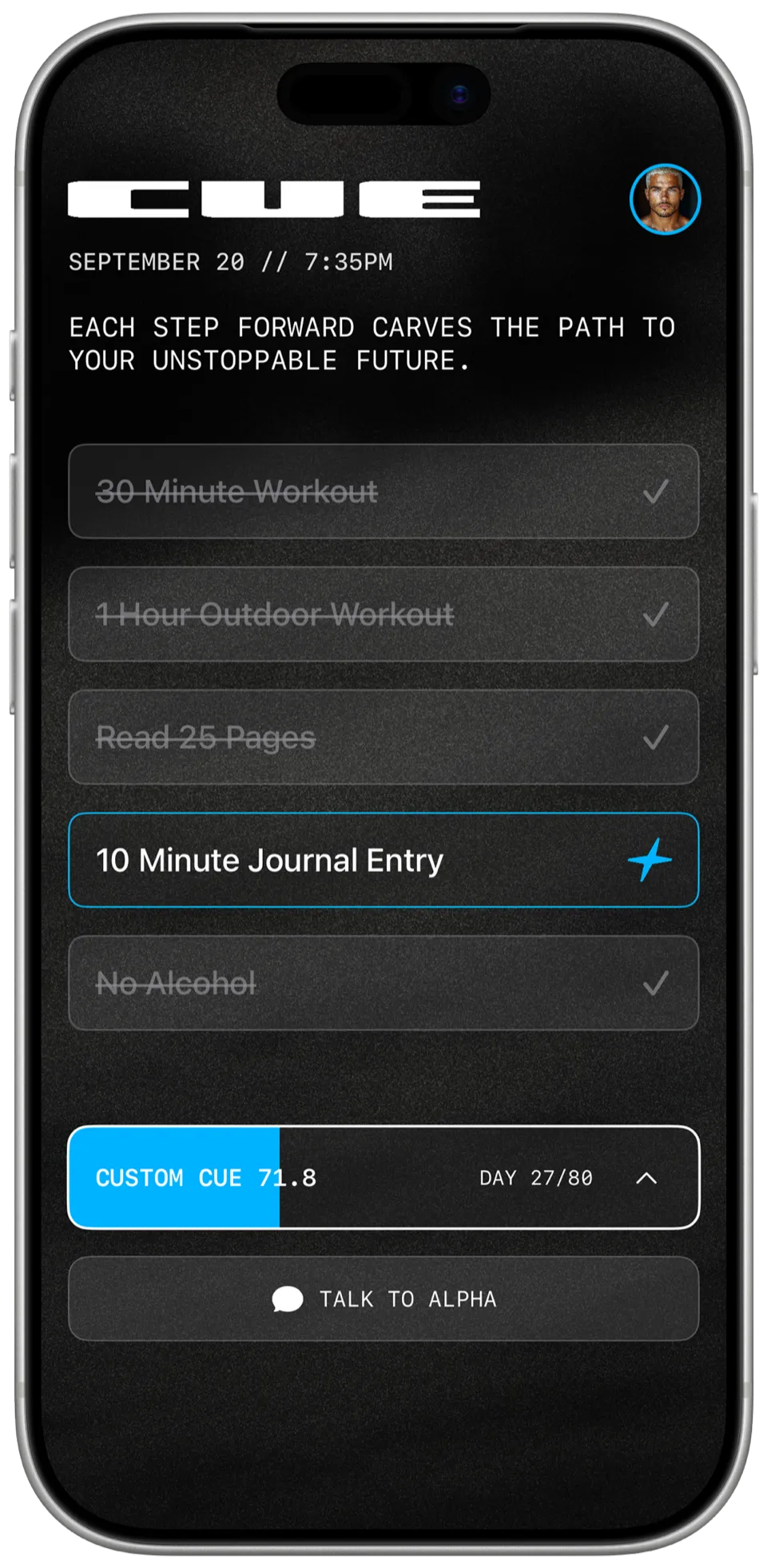
Cue is a challenge app built around exactly this structure. You define the challenge: fixed length, your daily tasks, all binary. Then you commit — and Cue enforces the parts you'd normally negotiate away:
- The restart rule is real. Miss a day and the challenge resets to Day 1. The app doesn't offer a soft restart, because a soft restart is just quitting with better branding.
- Commitment devices are built in. When you start a challenge, you choose your contract: a distraction lock, social accountability, or actual financial stakes. Quitting stops being free.
- Every day is a verdict. Complete every task and the day counts. The record of what you did — and didn't do — is permanent.
Build your winter arc as a custom challenge, set the dates, pick your contract, and start. The app's job is simple: make sure the person who finishes in March is the one the October version of you planned to become.
FAQ
When does a winter arc start?
There's no official date. Most people run October 1 or November 1 through New Year's Eve. Some run December through February. What matters is picking a fixed start and end before you begin.
Are there official winter arc rules?
No. Unlike 75 Hard, nobody owns this challenge. The common version: daily training, fixed wake-up, no alcohol, daily reading, limited social media. You define yours — then treat them as non-negotiable.
What happens if I miss a day?
You decide before you start, not in the moment. The strictest standard — and the one Cue enforces — is restart from Day 1. It's harsh, and it's the reason the commitment holds.
Can I start a winter arc late?
Yes. Starting December 1 and finishing beats waiting until next October. Shorten the arc, keep the rules fixed. A 30-day arc you complete is worth more than a 90-day arc you abandon.
Is the winter arc just about the gym?
No. Training is usually one rule of five. Most arcs combine physical work, focus rules, and abstinence rules. The theme is the same: while everyone else coasts, you build.