You're not at your limit. You're at the edge of your comfort zone. There's a difference.
Most people never discover what they're capable of because they spend their entire lives avoiding discomfort. They choose the path of least resistance. They optimize for ease. And in doing so, they lock their potential behind a door they're afraid to open.
Your potential isn't locked behind talent or genetics. It's locked behind your willingness to do uncomfortable things.
Comfort Is the Enemy of Growth
Every skill you've ever learned required discomfort. Walking. Talking. Reading. You failed repeatedly. You looked stupid. You struggled. And then, after enough repetition, it became easy.
The problem is most people stop there. Once something becomes comfortable, they stay. They plateau. They mistake comfort for competence.
But growth only happens outside your comfort zone. The moment something feels easy, you're no longer improving. You're maintaining.
If you want to unlock your potential, you have to actively seek discomfort. Not suffering. Not pain for the sake of pain. Productive discomfort — the kind that forces adaptation.
Your Brain Is Wired for Comfort
Your brain's primary job is to keep you alive. Not happy. Not successful. Alive.
From your brain's perspective, anything unfamiliar is a threat. New experiences. Hard workouts. Difficult conversations. Social pressure. Your brain treats all of it the same way: danger.
So it pushes you toward familiar patterns. Toward safety. Toward comfort. That's not weakness. That's biology.
But here's the problem: the same mechanism that kept your ancestors alive now keeps you mediocre. Your brain can't tell the difference between a real threat and a hard workout. So it resists both.
Unlocking your potential means overriding that resistance. Not once. Every single day.
Discomfort is a Signal, Not a Stop Sign
Most people treat discomfort like a warning: "This is too hard. I should stop."
But discomfort isn't a stop sign. It's a signal that you're pushing past your current limits. That you're in the zone where growth happens.
When you lift weights, your muscles don't grow during the workout. They grow during recovery — after you've created enough discomfort to trigger adaptation. Your nervous system works the same way. Your mindset works the same way.
If it's comfortable, you're not growing. If it's uncomfortable, you're on the right track.
The Cue Approach: Fixed Challenges, Zero Negotiation
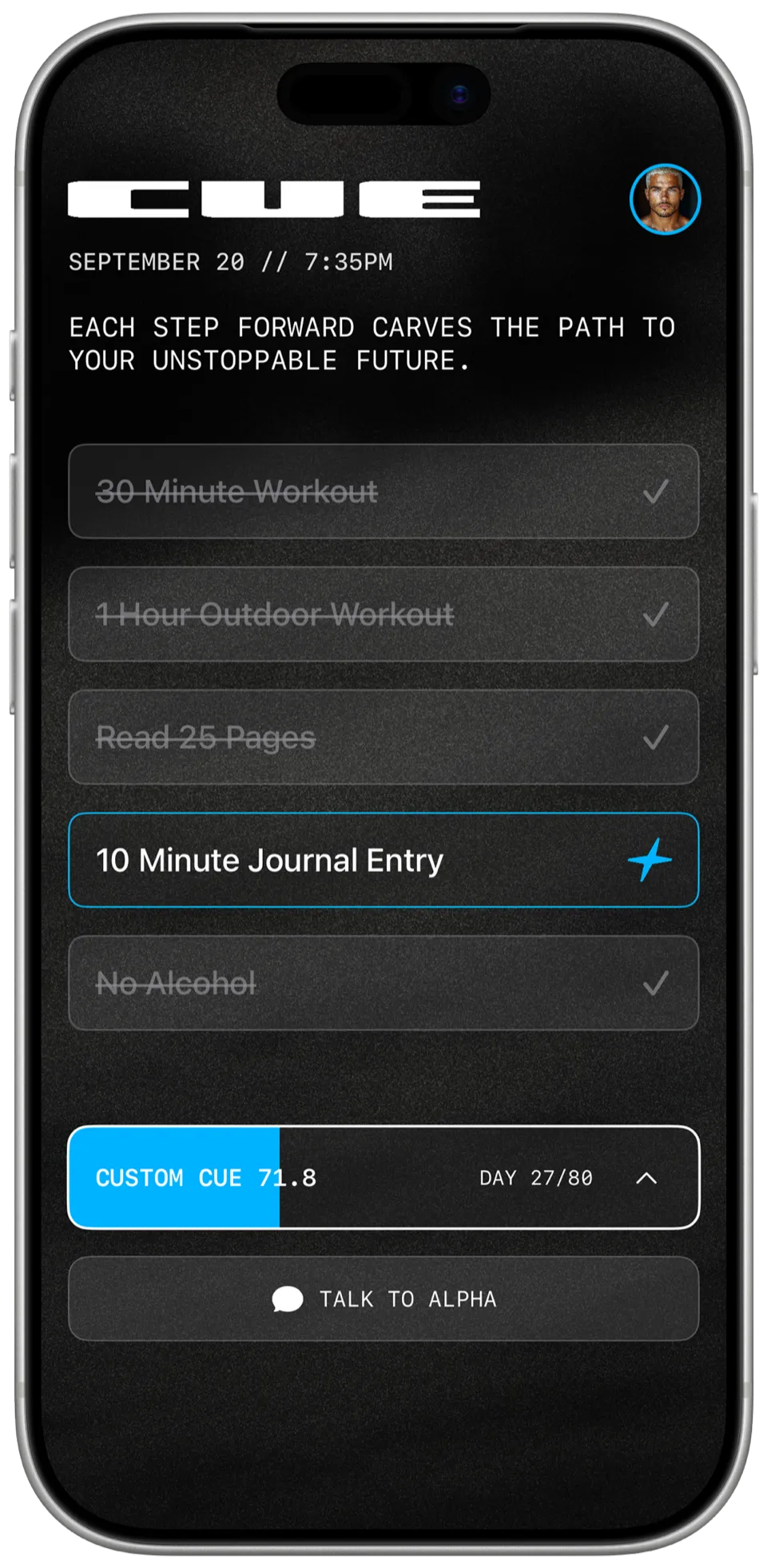
Cue is built around this principle. You don't ease into discomfort. You commit to a fixed challenge and execute.
30 days of cold showers. 60 days of no social media. 90 days of daily workouts. You set the rule, lock it in, and complete it. No flexibility. No ramp-up period. No "I'll start easy and build up."
That's not how real growth works. Real growth happens when you commit fully and execute through the discomfort.
Most apps let you adjust the difficulty when it gets hard. Cue doesn't. You either complete the day or you restart. That's the contract. That's how you unlock potential — by proving to yourself that you can do hard things without negotiating.
Examples of Productive Discomfort
Physical: Lift heavy. Run farther. Train in the cold. Push past the point where your body begs you to stop. That's where strength is built.
Mental: Read difficult material. Learn a new skill. Sit with boredom without reaching for your phone. Force your brain to focus without distraction.
Social: Have the hard conversation. Set the boundary. Say no. Risk rejection. That's where confidence comes from.
Emotional: Sit with anxiety instead of numbing it. Feel discomfort without escaping. Build tolerance for negative emotions.
All of these are uncomfortable. All of them unlock potential.
The Adaptation Cycle
Here's how it works:
Step 1: Discomfort. You do something hard. Your brain resists. Your body resists. Everything in you wants to quit.
Step 2: Adaptation. You push through. You complete the task. Your brain realizes the "threat" wasn't dangerous.
Step 3: Expansion. Your tolerance for discomfort increases. What felt unbearable yesterday feels manageable today. Your comfort zone expands.
Step 4: Repeat. You seek new discomfort. You push the boundary again. The cycle continues.
This is how potential is unlocked. Not through one big breakthrough. Through repeated exposure to discomfort until what once felt impossible becomes normal.
Discomfort Builds Self-Trust
Every time you do something uncomfortable and survive, you build evidence. Evidence that you're capable. Evidence that discomfort won't break you.
Most people lack confidence not because they don't believe in themselves, but because they have no evidence to support that belief. They've never done anything hard enough to prove they can.
When you commit to 30 days of cold showers, you're not just building physical tolerance. You're building proof that you can keep promises to yourself. That's where real confidence comes from.
Start Where You Are
You don't need to climb a mountain tomorrow. You need to do one uncomfortable thing today.
Take the cold shower. Do the hard workout. Have the difficult conversation. Say no when you want to say yes.
Pick one thing that makes you uncomfortable and commit to it for 30 days. Not as a trial. As a non-negotiable rule.
Use Cue to lock it in. Track every day. Miss one? Restart. That's the system. That's how you build capacity.
What You'll Discover
When you stop avoiding discomfort and start seeking it, something shifts.
You stop asking "Can I do this?" and start asking "What's next?"
You stop waiting for the right mood, the right moment, the right conditions. You act regardless.
And slowly, you discover that your potential was never limited by talent or genetics. It was limited by your willingness to be uncomfortable.
The door is unlocked. You just have to walk through it.