You missed the workout. You skipped the task. You broke the streak. Now you're explaining why.
Traffic was bad. Work was stressful. You didn't sleep well. Something came up.
All valid reasons. None of them matter.
Excuses protect your ego. They let you off the hook. They make failure feel okay. But they also keep you weak.
The no-excuses rule is simple: stop explaining why you didn't. Start executing regardless.
Why Excuses Feel Good
Excuses are comforting. They shift responsibility away from you. "I couldn't work out because I was tired." Now it's not your fault. It's the fatigue's fault.
That feels better than admitting: "I chose not to work out." Because that makes it your decision. Your failure. Your responsibility.
But here's the problem: when you remove responsibility, you remove control. If your actions are always determined by external factors, you're powerless. You're a victim of circumstance.
The no-excuses rule flips that. It says: circumstances don't control you. You control your response to circumstances.
The Excuse Cycle
You make an excuse once. It works. You feel relieved. The guilt fades. So you make another excuse next time. And another.
Soon, excuses become your default response. You don't even realize you're doing it. You automatically scan for reasons why you couldn't execute.
"I was busy." "I was tired." "It wasn't the right time."
The more you rely on excuses, the weaker you become. Because you're training your brain to look for reasons not to act instead of reasons to act.
The no-excuses rule breaks that cycle. It removes the option to justify failure. You either did it or you didn't. No explanation required.
What the No-Excuses Rule Actually Means
It doesn't mean circumstances don't exist. It means circumstances don't determine your actions.
Yes, you were tired. You still worked out.
Yes, you were busy. You still made time.
Yes, something came up. You still executed.
The rule isn't about denying reality. It's about refusing to let reality be your excuse.
How Cue Enforces This
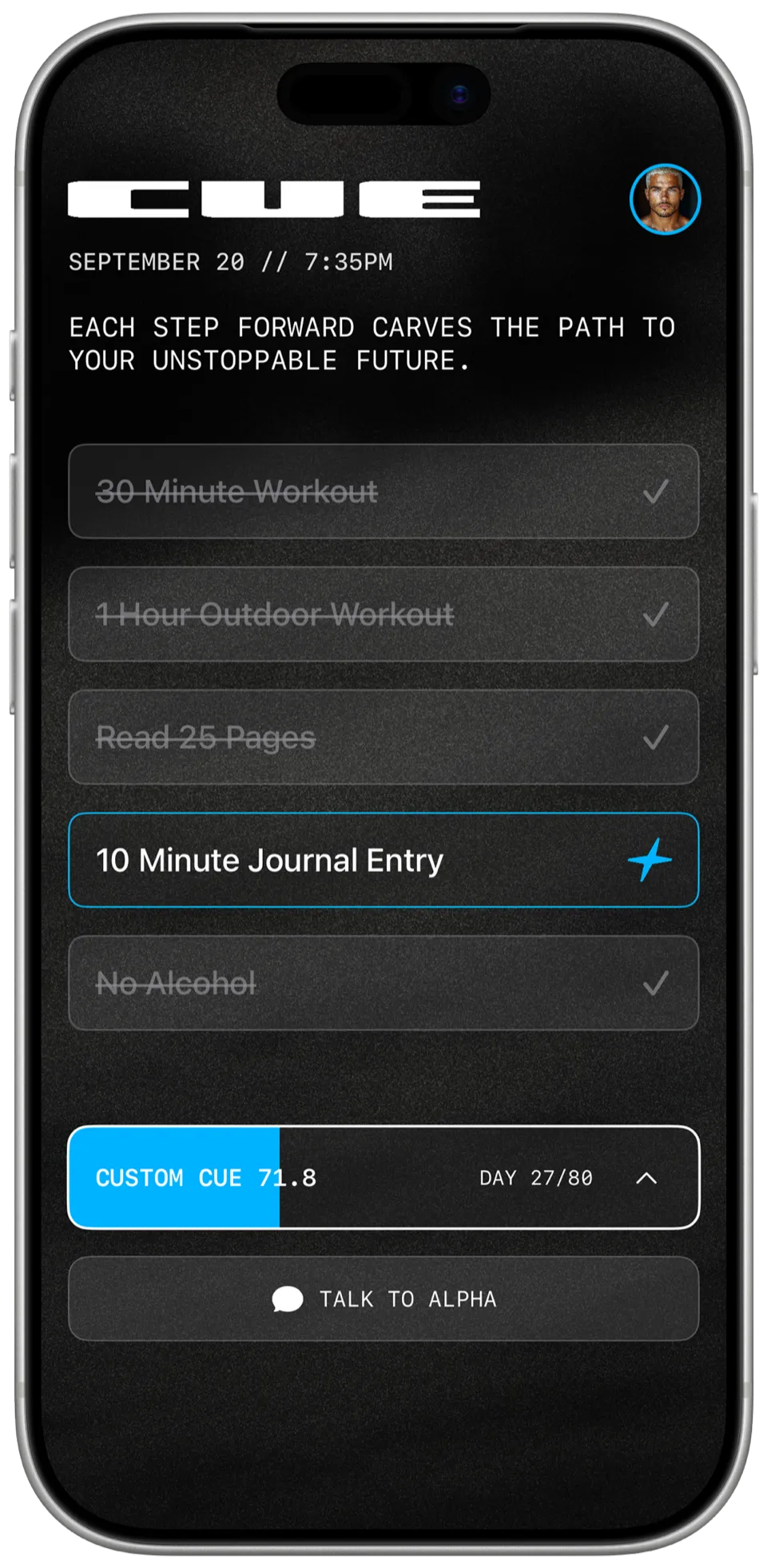
Cue doesn't care about your reasons. The app doesn't have a "why I missed today" field. No journaling about obstacles. No notes explaining your situation.
You either mark the day complete or you don't. Miss a day? Restart the challenge. No questions asked.
That structure forces accountability. It removes the gray area where excuses live. You can't negotiate with the app. You can't explain your way out of a miss.
The challenge is binary. Complete or incomplete. That's it.
Common Excuses (And Why They Don't Matter)
"I was too tired." You're always tired. Fatigue is a constant. If you wait until you're fully rested, you'll never act. Execute tired.
"I didn't have time." You had time. You chose to spend it on something else. Own that choice.
"Something came up." Something always comes up. Life is unpredictable. The rule doesn't change.
"I wasn't feeling it." You're never going to feel like it. Discipline means executing when you don't feel like it.
"I forgot." Then you didn't prioritize it. Set a reminder. Build a system. Forgetting is a choice.
Taking Responsibility
Responsibility isn't about blame. It's about ownership.
When you take responsibility, you stop being a victim. You stop waiting for perfect conditions. You stop explaining why things didn't work out.
You just act. And when you don't act, you don't make excuses. You restart. You adjust. You keep going.
That's power. Real power. Not the power to control circumstances. The power to control your response to circumstances.
The Uncomfortable Truth
Most of your excuses are valid. That's what makes them effective. They're rooted in reality.
But validity doesn't equal justification. Just because something is true doesn't mean it should stop you.
You were tired. True. Did you execute anyway? No? Then you chose comfort over commitment. Own that.
You were busy. True. Did you make time? No? Then you prioritized something else. Own that.
The no-excuses rule forces you to confront the gap between what you say you want and what you actually do.
How to Apply This
Step 1: Catch yourself making excuses. Pay attention to how often you explain why you didn't do something. Just notice it.
Step 2: Stop explaining. When you miss a task, don't justify it. Just acknowledge it. "I didn't do it." Full stop.
Step 3: Restart. Don't dwell on the miss. Don't beat yourself up. Just restart the challenge and keep going.
Step 4: Execute next time. Same circumstances. Different choice. That's how you prove to yourself that excuses don't control you.
What Changes
When you stop making excuses, something shifts. You stop seeing yourself as powerless. You stop waiting for the right moment. You stop negotiating with yourself.
You just execute. Tired? Doesn't matter. Busy? Doesn't matter. Not feeling it? Doesn't matter.
The task doesn't care about your mood. The challenge doesn't care about your circumstances. And neither should you.
The Restart Rule Reinforces This
In Cue, missing a day means restarting the challenge. Not quitting. Restarting.
That's the no-excuses rule in action. You don't get to explain why you missed. You don't get leniency because you had a hard day. You restart.
That structure builds resilience. It teaches you that missing isn't the end. Quitting is the end. As long as you restart, you're still in the game.
Start Now
Pick one challenge. Commit to it. No excuses.
If the excuse usually arrives as a repeated complaint, use the 30-day no-complaint challenge to convert it into a request, an action, or a deliberate release.
Not "I'll try." Not "I'll do my best." Commit. Set the rule. Execute daily. Track it in Cue.
Miss a day? No explanation. Restart.
30 days from now, you'll have proof that circumstances don't control you. That excuses don't define you. That you can execute regardless.
That's the no-excuses rule. And that's how you take full responsibility for your life.
If the rule is clear but you still keep negotiating, use the daily self-accountability system. If the thing you keep avoiding is the mess around you, the 10-minute cleaning start gives you a finish line small enough to execute now.