Your attention is broken. You know it. You can't sit through a single meeting without checking your phone. You can't read a full article without switching tabs. You can't work for 30 minutes without wondering what's happening on social media.
This isn't a personality flaw. It's conditioning. You've trained your brain to expect constant stimulation, and now it can't function without it.
Monk mode is how you break that cycle.
What Is Monk Mode?
Monk mode is a period of total elimination. No social media. No entertainment. No distractions. Just work, training, and recovery.
It's not a productivity hack. It's a reset. A forced recalibration of your attention span and your ability to do hard things without constant dopamine hits.
Most people can't go three days without scrolling. Monk mode forces you to go 30, 60, or 90 days. That's how you rebuild focus — through sustained deprivation and commitment.
Why Your Focus Is Destroyed
Your brain has been hijacked by apps designed to steal your attention. Every notification. Every autoplay video. Every infinite scroll. These aren't features. They're weapons.
The average person checks their phone 96 times per day. That's once every 10 minutes during waking hours. You're not focused. You're fractured.
Every time you switch tasks, your brain needs time to refocus. Studies show it takes an average of 23 minutes to fully re-engage after an interruption. If you're checking your phone every 10 minutes, you're never actually focused.
Monk mode removes the interruptions entirely.
The Rules of Monk Mode
Monk mode isn't flexible. It's binary. You're either in or you're not. Here's what it looks like:
No social media. Delete the apps. Not "I'll just check once a day." Delete them.
No entertainment. No Netflix. No YouTube. No podcasts unless they're directly related to your work. If it's designed to entertain, it's out.
No alcohol. Nothing that dulls your focus or delays your recovery.
Fixed daily structure. Same wake time. Same work blocks. Same training time. Eliminate decision fatigue by eliminating decisions.
Single focus. Pick one goal. One project. One thing you're building. Everything else is secondary.
These aren't suggestions. They're requirements. Break one rule and you restart the count.
How Cue Enforces Monk Mode
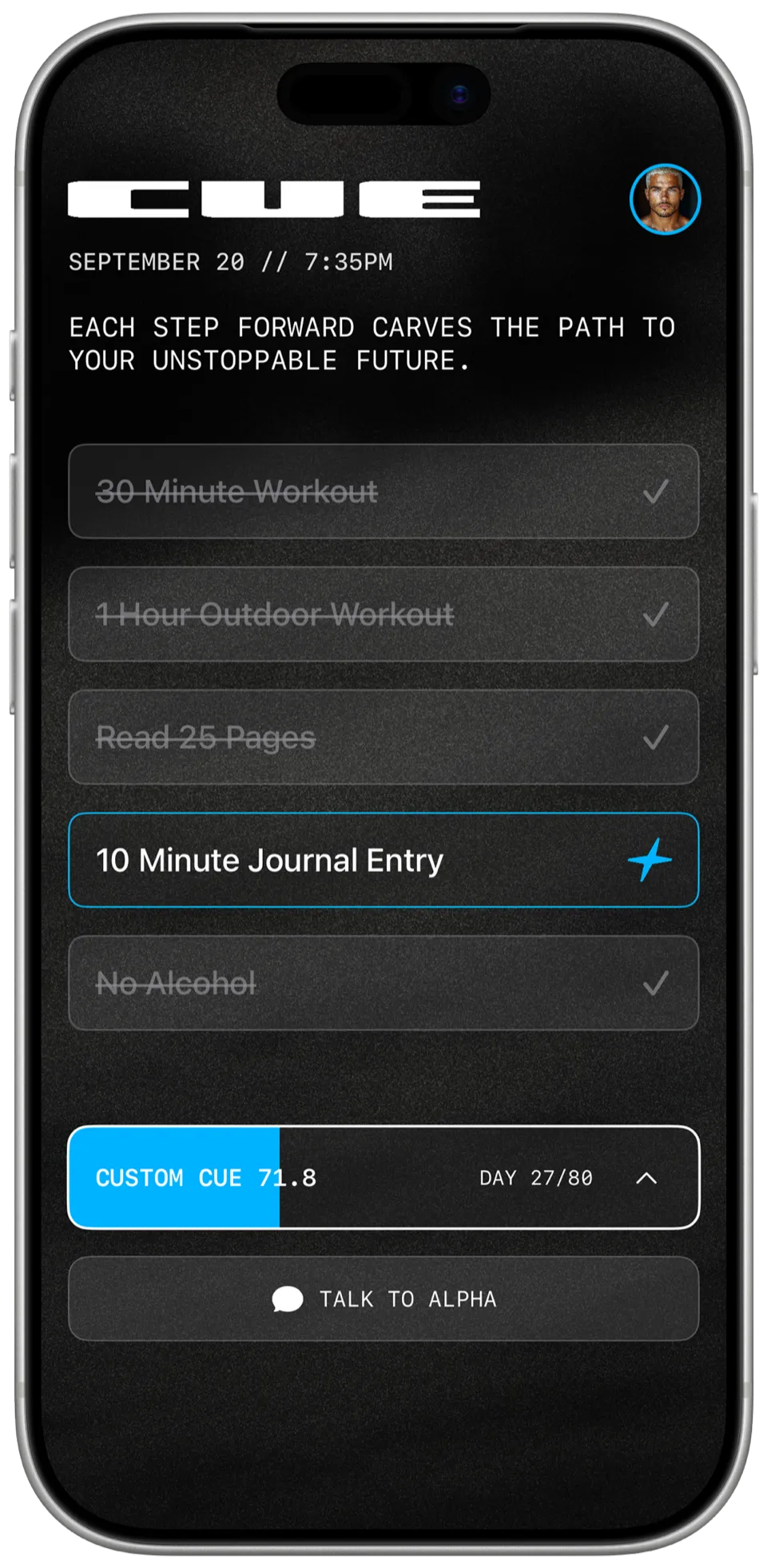
Cue is built for this. It's a no-nonsense discipline app designed around fixed-length challenges. You set the rules, lock them in, and commit for a set number of days.
There's no "progressive easing in." No "take it slow." You either complete the day or you restart.
Want to do 30 days of no social media? Lock it in. Miss one day? Restart. That's the system. It doesn't care about your excuses. It cares about your execution.
Most apps let you track streaks. Cue makes you earn them. The difference? Accountability.
The First Week Is Hell
Let's be honest: the first week of monk mode is brutal. You'll feel bored. Restless. Anxious. Your brain will scream at you to check your phone, watch something, do anything to escape the discomfort.
Good. That's the point.
The discomfort you're feeling isn't weakness. It's withdrawal. Your brain has been conditioned to expect constant stimulation. Now that the stimulation is gone, it's panicking.
Sit with it. Don't negotiate. Don't compromise. This is the test.
Week Two: The Shift
Something changes in week two. The urges don't disappear, but they weaken. You stop reaching for your phone out of reflex. You stop thinking about what you're missing.
Your focus starts to return. Not fully. But enough that you notice. You can work for an hour without distraction. You can read without losing your place. Small wins, but they compound.
This is where most people quit. They feel better and assume they've "fixed" the problem. They reintroduce distractions "in moderation." Within a week, they're back where they started.
Don't stop. Keep going.
Week Three and Beyond: Recalibration
By week three, monk mode becomes normal. The deprivation that felt unbearable two weeks ago now feels natural. You're no longer fighting the system. You're operating within it.
This is where real work happens. Your brain is no longer distracted. Your energy is no longer fragmented. You're locked in.
Whatever goal you set at the start — finish the project, build the business, complete the training program — you're actually making progress. Not thinking about progress. Making it.
What You Gain
Monk mode isn't about what you give up. It's about what you gain.
Focus. The ability to work deeply without distraction. The ability to think clearly without mental noise.
Self-command. Proof that you can do what you said you'd do. That's the foundation of confidence.
Results. You'll complete more in 30 days of monk mode than most people complete in six months of half-focused effort.
Monk Mode Isn't Forever
Monk mode is a sprint, not a lifestyle. You go in, rebuild your focus, complete your goal, and exit. 30 days. 60 days. 90 days max.
After that, you reintroduce distractions selectively. But you'll notice something: you won't want them back. The things that used to fill your time now feel hollow. You've built a new standard.
Starting Monk Mode
Pick a duration. 30 days minimum. Lock in your rules. No negotiation. No "I'll start Monday." Start now.
Use Cue to track it. Set your daily rules — no social media, no entertainment, fixed work blocks — and commit. Miss a day? Restart. That's the contract.
The first few days will be uncomfortable. The first week will be hard. But by week three, you'll understand why people who complete monk mode never go back to their old patterns.
You don't need motivation. You need elimination. Cut the distractions. Lock in the rules. Go all in.
Your focus is waiting on the other side.