You want to build new habits. But remembering to do them is the hard part.
You tell yourself "I'll meditate every day." Then you forget. Or you remember at 11 PM when you're already in bed.
The problem isn't motivation. It's lack of a trigger. Your brain needs a cue to execute the habit. Without one, the habit dies.
Habit stacking solves this. You attach a new habit to an existing one. The existing habit becomes the trigger. No willpower required.
What Habit Stacking Is
Habit stacking is simple: After [EXISTING HABIT], I will [NEW HABIT].
You're not creating a habit from scratch. You're piggybacking on something you already do automatically.
After I pour my coffee, I'll do 10 push-ups.
After I brush my teeth at night, I'll write in my journal for 2 minutes.
After I sit down at my desk, I'll write one sentence.
The existing habit acts as the cue. Your brain already has a neural pathway for it. You're just adding one more step to the sequence.
Why It Works
Your brain loves automation. Once a behavior becomes automatic, it requires almost zero willpower. You don't debate brushing your teeth. You just do it.
Habit stacking leverages that automation. By linking a new habit to an automatic one, you bypass the need for motivation. The trigger does the work for you.
You don't need to remember to meditate. You just need to remember: "After I brush my teeth, I meditate." Once you brush your teeth, the rest is automatic.
How to Choose the Right Anchor
Not every existing habit makes a good anchor. You need something that's already automatic and happens at a consistent time.
Good anchors:
• After I pour my morning coffee
• After I close my laptop at the end of the workday
• After I sit down for dinner
• After I brush my teeth before bed
• After I get in my car
Bad anchors:
• After I feel motivated (feelings are unreliable)
• After I have free time (too vague)
• When I remember (you won't)
Pick a specific, consistent behavior you already do daily. That's your anchor.
Example 1: Morning Stack
Goal: Start the day with intention instead of scrolling your phone.
Anchor: After I pour my coffee.
New habit: I will write down three priorities for the day.
Why it works: You already make coffee every morning. It's automatic. Now, before you take the first sip, you write three things. Two minutes. Done.
After 30 days, this becomes automatic. You won't drink coffee without planning your day first. The two behaviors are now linked.
Example 2: Workday Stack
Goal: Build physical activity into your workday.
Anchor: After I close my laptop for lunch.
New habit: I will do 20 push-ups.
Why it works: Lunch happens every day. You're already breaking from work. Adding 20 push-ups takes 30 seconds. The timing is consistent. The anchor is solid.
After a month, closing your laptop triggers the push-ups. You don't think about it. You just do it.
Example 3: Evening Stack
Goal: Reflect on the day and clear your mind before sleep.
Anchor: After I brush my teeth at night.
New habit: I will write three things I'm grateful for.
Why it works: You brush your teeth every night. It's the last thing you do before bed. Adding two minutes of gratitude journaling right after creates a calming evening routine.
Within weeks, brushing your teeth will feel incomplete without the journaling. The stack is locked in.
Start Small
Most people try to stack too much too fast. They create a 10-step morning routine and burn out in three days.
Start with one stack. One anchor. One new habit. Execute it for 30 days. Make it automatic. Then add another.
Don't build a routine. Build a system. One stack at a time.
Track Your Stacks
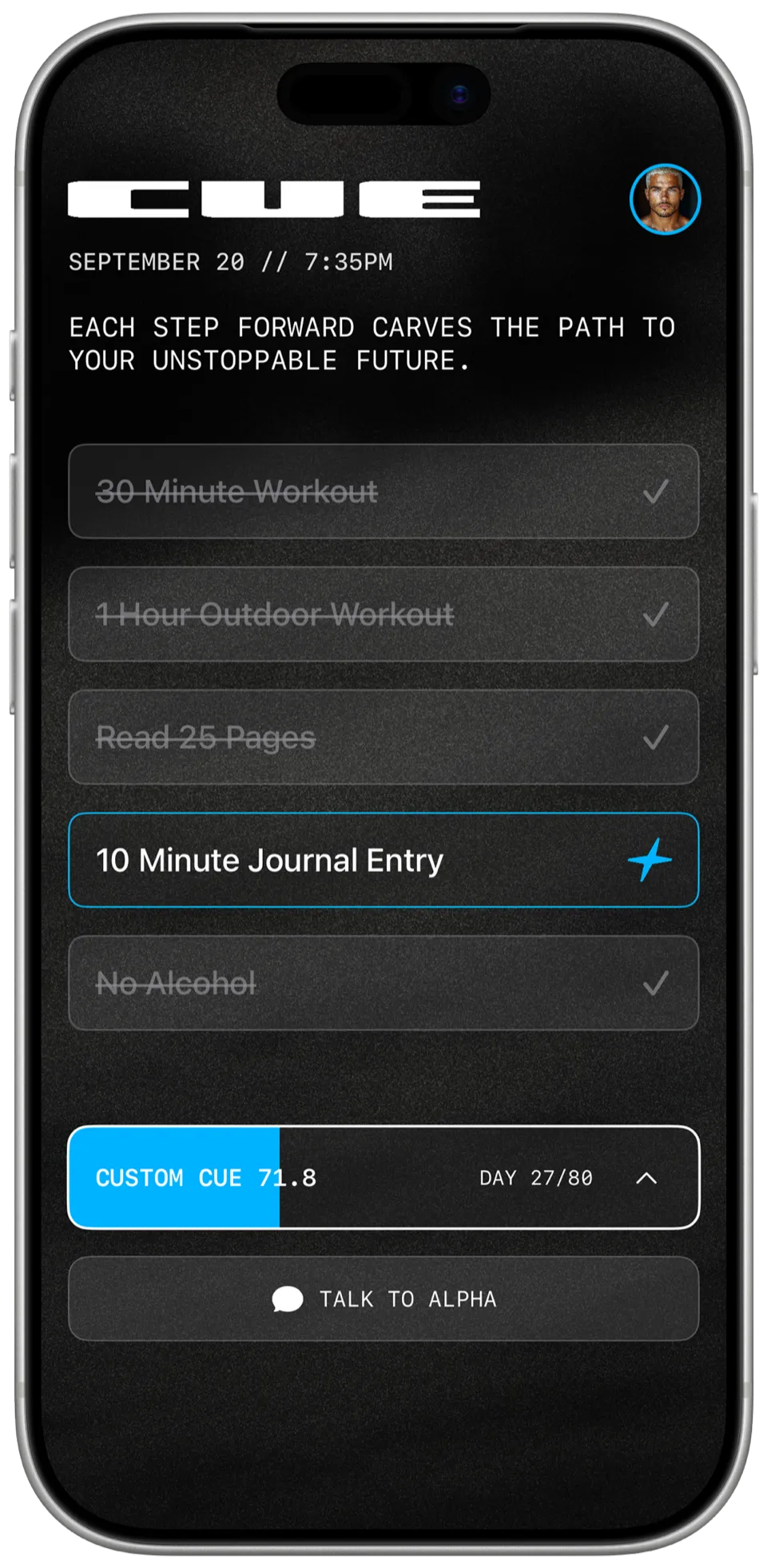
Habit stacking works better when you track it. Use Cue to set a 30-day challenge for your stack.
"After I pour my coffee, I will write three priorities." Track it daily. Miss one? Restart.
The tracking builds accountability. The restart rule forces honesty. And after 30 days, the stack is automatic.
Common Mistakes
Mistake 1: Vague anchors. "After I wake up" is not specific enough. "After I pour my coffee" is.
Mistake 2: Too many stacks at once. One stack. Master it. Then add another.
Mistake 3: Picking a weak anchor. If your anchor habit isn't consistent, the stack will fail. Choose something you do every single day.
Mistake 4: Making the new habit too big. 2 minutes is better than 20. Start small. Scale later.
Start Tonight
Pick one existing habit. Pick one new behavior you want to add. Link them.
"After I [existing habit], I will [new habit]."
Set the challenge in Cue. Track it for 30 days. Execute without negotiation.
That's how habits stick. Not through motivation. Through structure.
For a ready-made version, turn opening your notes into the anchor for this five-minute study protocol. The first block is deliberately small; the repeat is what matters.