Your brain is fried. You can't focus for 10 minutes without reaching for your phone. Reading feels hard. Boredom feels unbearable. Basic tasks feel exhausting.
That's not laziness. That's dopamine dysregulation. Your brain has been hijacked by high-stimulation activities that flood you with dopamine hits. Now normal activities feel boring in comparison.
You don't need to quit life to fix this. You just need to remove the noise for a fixed period and let your brain recalibrate.
What a Dopamine Detox Actually Is
A dopamine detox isn't about avoiding all dopamine. That's impossible. Dopamine is a neurotransmitter involved in motivation, reward, and focus. You need it.
What you're detoxing from are high-stimulation, low-effort activities that flood your brain with dopamine without requiring work.
Social media. Porn. Video games. Junk food. Endless scrolling. These activities hijack your reward system. They train your brain to expect instant gratification without effort.
A dopamine detox removes these activities temporarily. Not forever. For a fixed period. 7 days. 14 days. 30 days. Long enough for your brain to reset its baseline.
Why Your Brain Needs This
Every time you get a notification, scroll through TikTok, or binge a show, your brain releases dopamine. That feels good. So you do it again. And again.
Over time, your brain adapts. It downregulates dopamine receptors. Now you need more stimulation to feel the same reward. That's tolerance.
Meanwhile, normal activities — reading, working, exercising — don't provide enough dopamine to feel satisfying. So you avoid them. You reach for your phone instead.
A dopamine detox breaks this cycle. By removing high-stimulation activities, you force your brain to find satisfaction in lower-stimulation tasks. Your baseline resets. Focus returns.
What to Remove
You don't need to live like a monk. You just need to remove the activities that provide the most stimulation for the least effort.
Social media. Instagram. TikTok. Twitter. Reddit. All of it. These platforms are engineered to hijack your attention. Delete the apps. Log out. Remove access.
Video games. High-stimulation, high-reward, zero real-world benefit. Remove them for the duration of the detox.
Porn and sexual content. Supernormal stimuli that dysregulate your reward system faster than anything else. Cut it completely.
Junk food. Hyper-palatable foods flood your brain with dopamine. Stick to whole foods during the detox.
Binge-watching shows. One episode is fine. Six hours on Netflix is dopamine flooding. Remove it.
Mindless phone scrolling. News apps. YouTube rabbit holes. Anything that pulls you into endless consumption.
What You Can Do Instead
You're not removing stimulation entirely. You're replacing high-stimulation, low-effort activities with low-stimulation, high-reward activities.
Read. Books. Long-form articles. Things that require focus and thought.
Exercise. Lift. Run. Move your body. Physical activity releases dopamine in a healthy way.
Work. Focus on deep work. Projects. Things that require effort and produce results.
Socialize in person. Real conversations. Not texting. Not DMs. Face-to-face interaction.
Create. Write. Build. Make something. Creation feels harder than consumption, but it's more rewarding.
Sit with boredom. This is the hard part. Your brain will scream for stimulation. Don't give in. Let yourself be bored. That discomfort is the detox working.
The First 3 Days Are Hell
Day 1: You'll feel restless. Your brain will beg for stimulation. You'll reach for your phone every 5 minutes out of habit.
Day 2: Worse. You'll feel irritable. Bored. Like nothing is interesting. That's withdrawal. Your brain is recalibrating.
Day 3: Still hard. But slightly easier. You'll start noticing moments of clarity. Brief windows where focus feels possible again.
Push through. The discomfort is proof it's working.
What Happens After a Week
After 7 days of removing high-stimulation activities, something shifts.
Reading doesn't feel like a chore. It feels engaging.
Working doesn't require constant breaks. You can focus for longer stretches.
Boredom becomes tolerable. You stop needing constant stimulation to feel okay.
That's your baseline resetting. Your brain is relearning how to find satisfaction in normal activities.
How Cue Helps
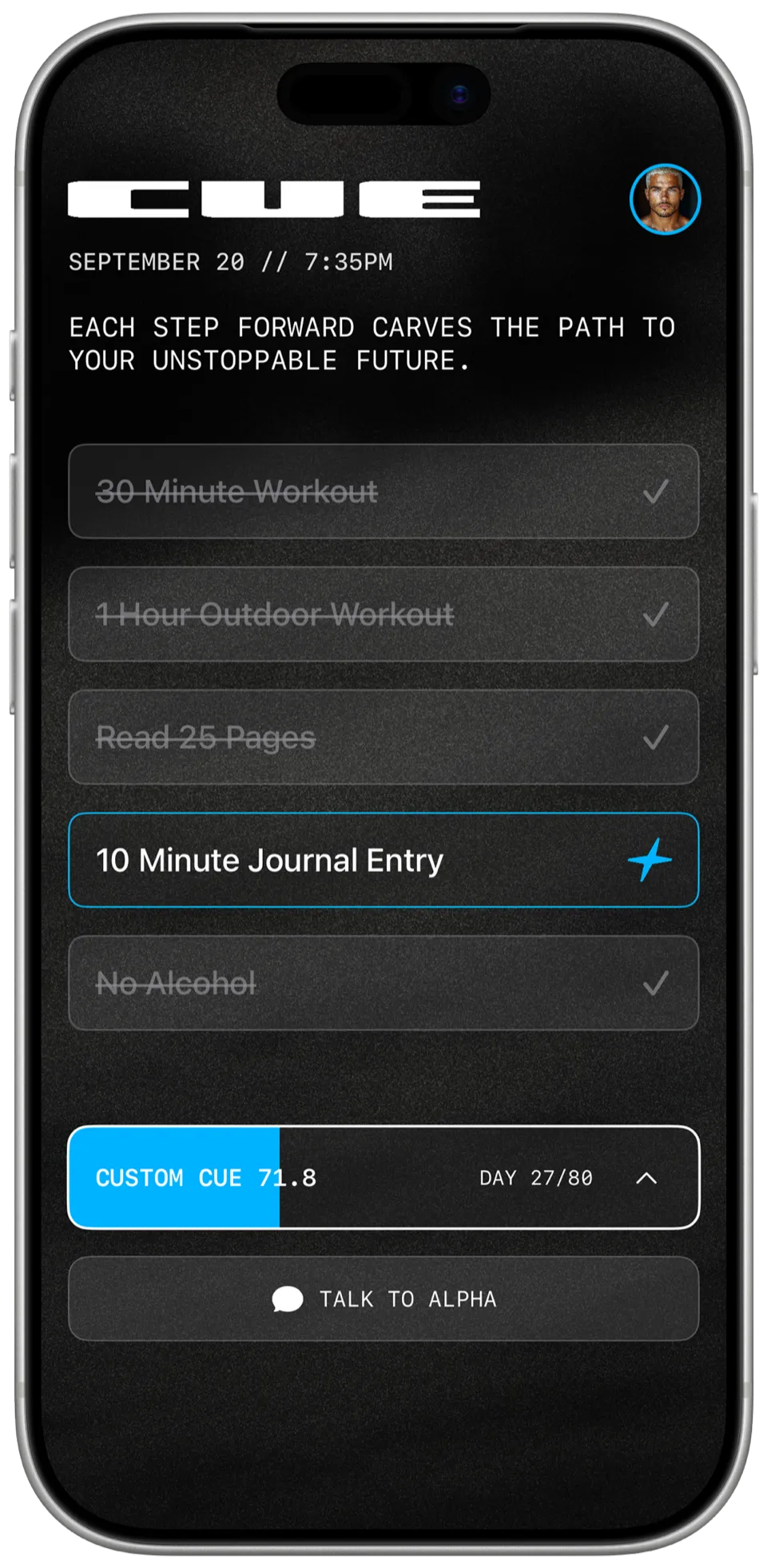
Cue turns your dopamine detox into a fixed challenge. 14 days. 30 days. Whatever you commit to.
You set the rules. No social media. No video games. No junk food. Lock it in. Track every day.
Miss a day? Restart. That's the system. No negotiation. No "I'll just check Instagram for a second." Either you follow the rules or you restart.
That structure removes the gray area. It forces commitment. And commitment is what makes a dopamine detox work.
Common Mistakes
Mistake 1: Trying to do it forever. A dopamine detox is temporary. 7 days. 14 days. 30 days. Not permanent. The goal is to reset, not quit forever.
Mistake 2: Not removing everything at once. "I'll just cut social media but keep video games" doesn't work. You're still flooding your brain with dopamine. Remove all high-stimulation activities at once.
Mistake 3: Not replacing with anything. If you remove stimulation without adding structure, you'll just sit around feeling miserable. Replace consumption with creation. Replace scrolling with reading. Replace gaming with exercise.
Mistake 4: Quitting after one slip. You checked Instagram. You played one game. That's not failure. Restart the challenge and keep going. The restart rule builds resilience.
After the Detox
After 30 days, your brain has reset. Now what?
You don't need to stay off social media forever. But you've proven you can live without it. That gives you control.
Reintroduce activities slowly. Set rules. "I'll check Instagram once a day for 10 minutes." "I'll play video games on weekends only."
The detox isn't about permanent removal. It's about proving to yourself that you're in control. That these apps don't control you.
Start Today
Pick your duration. 7 days. 14 days. 30 days.
List the activities you're removing. Social media. Video games. Junk food. Porn. Whatever floods your brain with easy dopamine.
Set the challenge in Cue. Track every day. Execute without negotiation.
30 days from now, your brain will work differently. Focus will feel easier. Boredom will feel tolerable. And you'll have proof that you can control your attention.