You already know what you need to do. You just don't do it.
Every Monday morning you're convinced this is the week. You set your alarm early. You prep your gym clothes. You feel ready. Then by Wednesday, you're back to snoozing through your workout and promising yourself you'll start again next week.
The problem isn't you. The problem is you're relying on motivation.
Motivation Is Weak Currency
Motivation is an emotion. Like all emotions, it comes and goes. It spikes when you watch an inspiring video or read a powerful quote. It vanishes the moment you're tired, stressed, or just don't feel like it.
Building your life on motivation is like building a house on sand. It feels solid until the first wave hits.
Discipline is different. Discipline doesn't care how you feel. It doesn't negotiate with your mood. It's a system, not a feeling.
Most people wait for motivation to show up before they act. Disciplined people act regardless of whether motivation shows up or not. That's the difference between wanting to change and actually changing.
The Motivation Trap
Here's what the self-help industry won't tell you: waiting to "feel motivated" is a stalling tactic. It's your brain buying time, hoping you'll forget about the hard thing you're supposed to do.
Motivation promises comfort. It says, "You'll do it when you're ready." But ready never comes. There's always another reason to wait.
Discipline strips away the option to wait. It replaces "when I feel like it" with "because I said I would."
How Cue Builds Discipline, Not Motivation
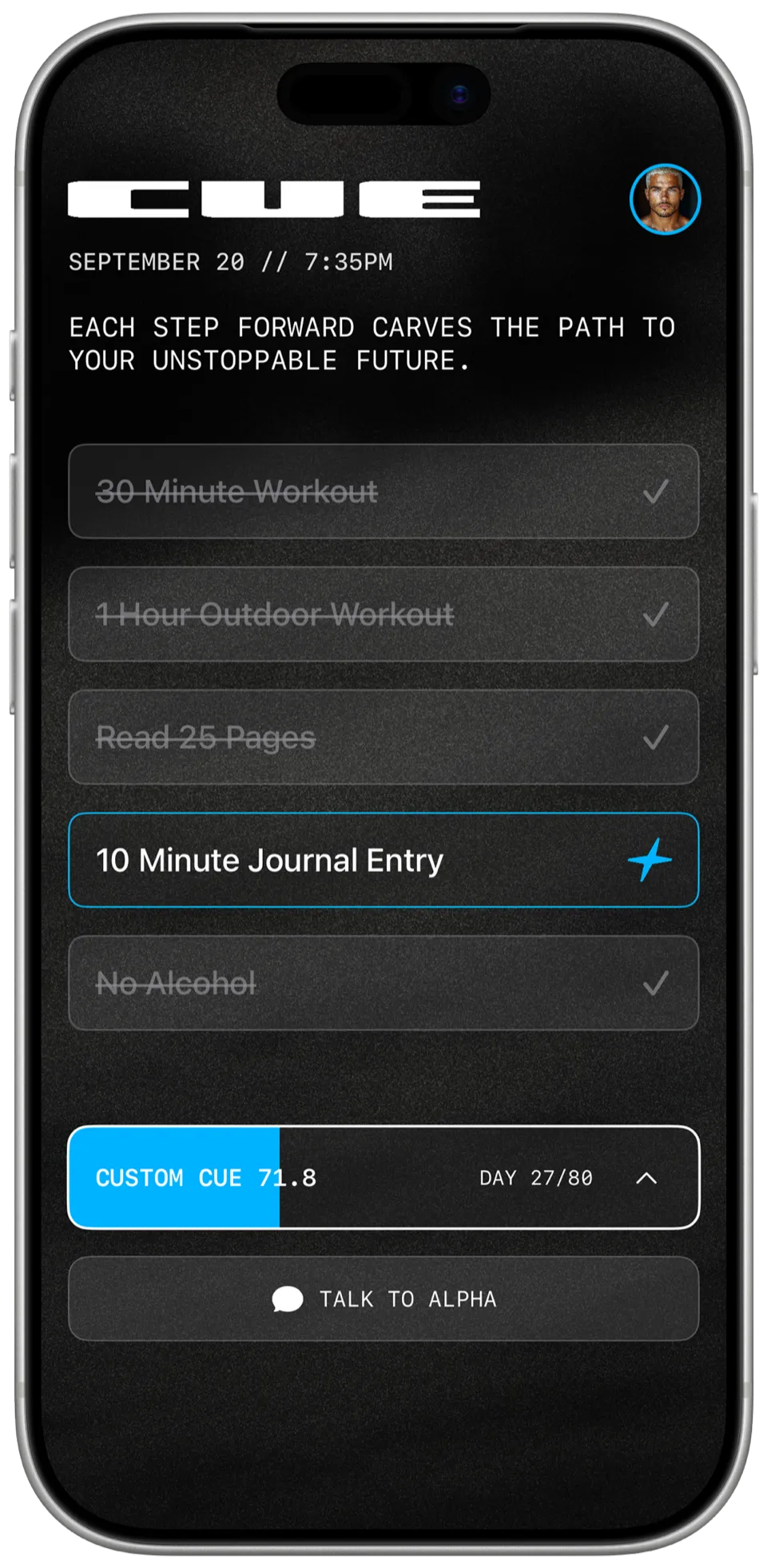
Cue isn't a habit tracker. It's a commitment device — an app that turns your goals into fixed-day challenges. You set the rules, lock them in, and commit for a set number of days. There's no "progressive easing in," no "listen to your feelings."
You either do it, or you restart.
Most apps track your streaks. Cue makes you earn them. There's no flexibility, no "skip days," no adjusting the difficulty when it gets hard. You commit to 30 days of cold showers, or 50 pushups, or no social media — and every single day counts.
Miss one day? Restart.
That's not punishment. That's the system teaching you that your word matters more than your mood.
Why Discipline Beats Motivation Every Time
Motivation is temporary. Discipline is permanent.
When you rely on motivation, your behavior depends on external factors: how you slept, what happened at work, whether someone said something discouraging. Your progress is fragile.
When you build discipline, your behavior depends on one thing: what you decided. You don't negotiate with your goals. You execute.
Discipline compounds. Every time you do the hard thing when you don't feel like it, you prove to yourself that you're capable. You build self-trust. That's the real currency of change.
Rules Don't Care About Your Feelings
Here's the secret disciplined people understand: rules are stable, feelings are not.
If your rule is "workout every morning at 6 AM," that rule doesn't change based on how you feel. It doesn't matter if you're tired. It doesn't matter if it's cold outside. The rule stays the same.
Your feelings will try to convince you to skip. They'll say, "Just this once won't hurt." But once becomes twice. Twice becomes a pattern. And suddenly you're back where you started.
Discipline means honoring the rule even when your feelings scream at you to break it.
Building Systems That Don't Negotiate
Want to build discipline? Stop trying to "get motivated" and start building systems that remove the option to quit.
Set fixed rules. Not flexible guidelines. Not goals you'll "try your best" to hit. Exact, measurable rules. 100 pushups. No phone for the first hour after waking. Read 20 pages. No exceptions.
Commit to a fixed timeframe. 30 days. 60 days. 90 days. Long enough that it's uncomfortable. Long enough that motivation will fail you multiple times. That's the point.
Accept that failure means restart. Missing a day isn't the end. But it's also not free. You restart the count. Zero. That's how the system teaches accountability.
The Binary Contract
In Cue, challenges are binary. You either complete the day or you fail and restart. There's no "I almost did it" or "I did 80% so that counts."
Binary thinking removes ambiguity. It removes the mental negotiation that kills progress. Did you do it? Yes or no.
This isn't harsh. This is honest. You can't negotiate your way to strength. You can't compromise your way to discipline. You have to earn it through unbroken execution.
What Happens When You Stop Waiting for Motivation
When you stop waiting to feel motivated and start honoring your commitments regardless of how you feel, everything changes.
You stop being a victim of your emotions. You stop making excuses. You stop starting over every Monday.
You become someone who does what they say they'll do. That version of you doesn't need motivation. They have something better: self-command.
Discipline Is Self-Respect
Every time you follow through when you don't feel like it, you're proving to yourself that your word means something. You're building the most valuable form of confidence: trust in your own reliability.
Motivation asks, "Do I feel like it?" Discipline answers, "It doesn't matter."
Stop chasing motivation. Build rules that don't care about your feelings. Lock in a challenge. Commit to the full duration. No safety net. No plan B.
You've tried motivation. Now try commitment.