You had the perfect workout last Monday. Killed it. Felt strong. Then skipped Wednesday. Made it back Friday. Skipped next Monday.
Now it's been two weeks since you trained consistently. And you wonder why you're not making progress.
The problem isn't your program. It's your consistency. Intensity doesn't build results. Showing up does.
Why Consistency Beats Intensity
One perfect workout doesn't build muscle. 50 mediocre workouts do.
You can train harder than anyone for one session. But if you skip the next three, you're not building anything. You're just spinning your wheels.
Consistency compounds. Every session builds on the last. Skip one, and you lose momentum. Skip three, and you're starting over.
The person who trains three days a week for 12 weeks beats the person who trains five days a week for three weeks. Every time.
Why People Skip Workouts
Excuse 1: "I'm too tired." You're always tired. Fatigue is constant. If you wait until you're fully rested, you'll never train.
Excuse 2: "I don't have time." You have time. You chose to spend it on something else. Own that choice.
Excuse 3: "I'm not feeling it." You're never going to feel like it. That's the point. Discipline means training when you don't feel like it.
Excuse 4: "I'll make it up tomorrow." No, you won't. Tomorrow you'll have a different excuse.
These aren't reasons. They're negotiations. And negotiation kills consistency.
The Rule: No Negotiation
Consistency requires removing negotiation. You don't ask yourself "Should I train today?" The answer is already decided.
Monday, Wednesday, Friday. You train. Not because you feel like it. Because that's the rule.
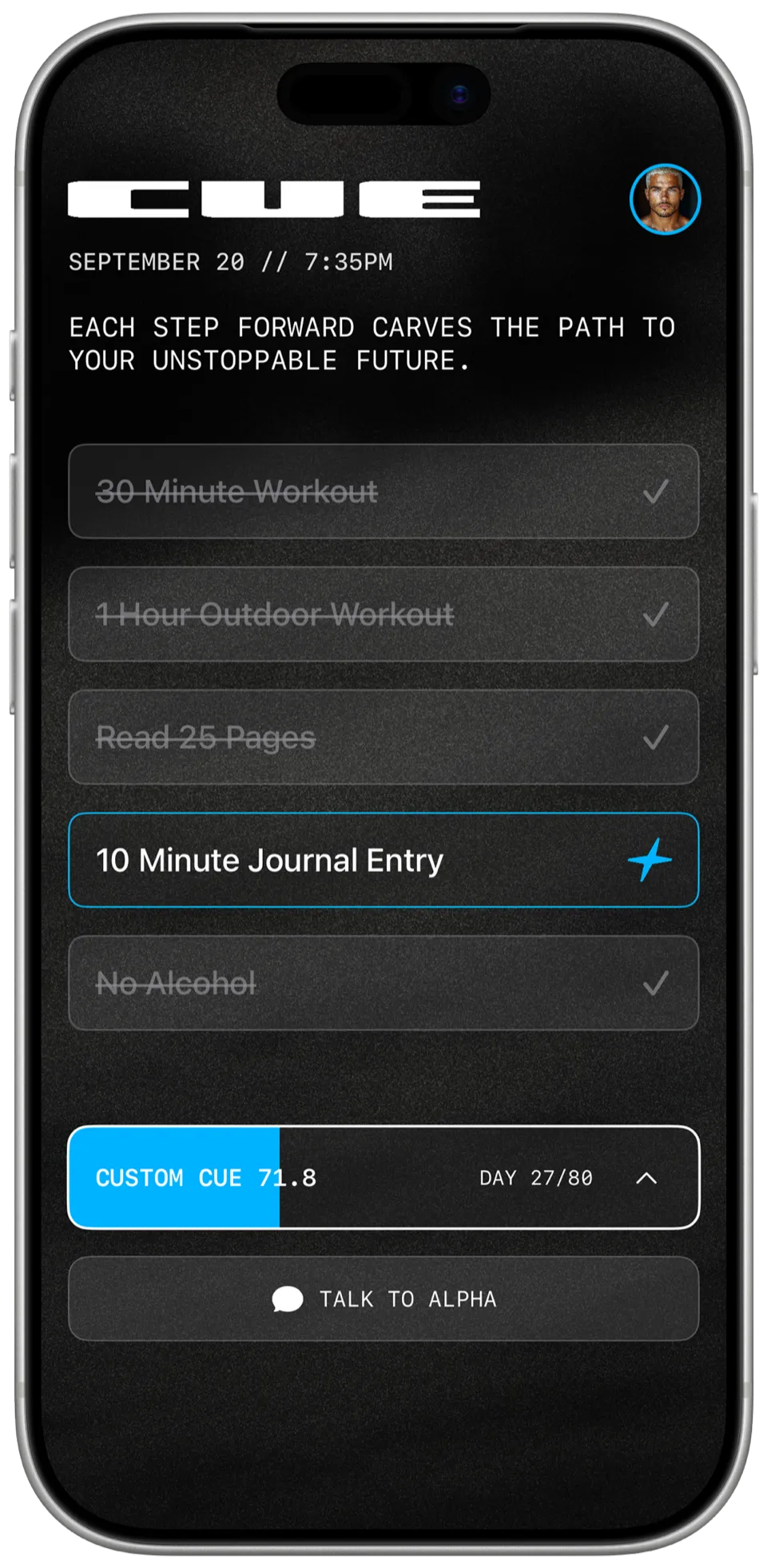
Cue enforces this. You set a challenge: 3 training days per week for 30 days. You track every session. Miss one? Restart.
The restart rule removes negotiation. You can't skip and pretend it doesn't matter. You skip, you restart. That's accountability.
How to Never Skip Again
Step 1: Lock in the schedule. Pick three non-consecutive days. Monday, Wednesday, Friday. Or Tuesday, Thursday, Saturday. Lock them in. Non-negotiable.
Step 2: Remove friction. Pack your gym bag the night before. Set your clothes out. Remove every excuse to skip.
Step 3: Lower the bar. You don't need a perfect workout. You need to show up. Even if it's just 20 minutes. Showing up is the win.
Step 4: Track it. Use Cue. Check off every session. Build the streak. Protect it.
Step 5: Restart if you miss. Don't quit. Restart. That's the system.
The Power of Showing Up
Some days you'll feel strong. Other days you won't. Both days count.
The weak days matter more. Because those are the days you prove consistency beats feelings. You didn't feel like training. You did it anyway. That's discipline.
After 30 days of never skipping, training becomes automatic. You don't debate it. You just go. That's when consistency becomes effortless.
The Compound Effect
One workout doesn't change much. But one workout per week for a year is 52 sessions. That changes everything.
Three workouts per week for a year is 156 sessions. You can't train 156 times without seeing results. It's impossible.
The problem is most people never get there. They skip too often. They lose momentum. They quit.
Consistency over 12 weeks beats intensity over 3 weeks. Always.
What Happens When You Never Skip
After 30 days of consistent training, your body adapts. You get stronger. Your recovery improves. The workouts feel easier.
After 60 days, training becomes non-negotiable. It's not something you do when you feel like it. It's part of your identity.
After 90 days, you look different. People notice. You notice. And it's not because of one great workout. It's because you never skipped.
The Restart Rule Builds This
Cue's restart rule forces consistency. You miss one session? You restart the 30-day challenge.
That structure removes the "I'll make it up" excuse. You don't make it up. You restart. And restarting sucks. So you don't skip.
After restarting once, you protect the streak harder. You plan better. You remove friction. You show up no matter what.
That's how consistency is built. Not through motivation. Through structure that makes skipping costly.
Lower the Bar to Raise Consistency
Most people skip because they set the bar too high. "I need to train for 90 minutes." Then life gets busy. They can't fit 90 minutes. So they skip.
Lower the bar. 20 minutes is enough. 10 minutes is better than nothing. Showing up is the win.
Once you're at the gym, you'll usually train longer. But even if you don't, you protected the streak. You proved you can show up. That's what matters.
The Identity Shift
After 30 days of never skipping, you stop seeing yourself as someone who "tries to work out." You're someone who trains. Consistently.
That identity shift is powerful. Because once training is part of your identity, skipping feels wrong. It doesn't match who you are.
That's when consistency becomes permanent. Not because you force it. Because it's who you've become.
Start Today
Pick three training days. Lock them in Cue. Set a 30-day challenge. Track every session.
Show up on the days you don't feel like it. Show up tired. Show up busy. Show up anyway.
Miss a day? Restart. Then show up again.
30 days from now, consistency won't feel hard. It will feel automatic. Because you built the system. And the system works.