
You know your bad habits. Scrolling for hours. Eating junk when you're stressed. Hitting snooze. Drinking too much. Procrastinating on everything that matters.
You've tried quitting before. You made it a few days, maybe a week. Then you slipped. And once you slipped, you told yourself you'd start again Monday. But Monday never came.
Breaking bad habits doesn't require willpower. It requires a system that doesn't let you negotiate.
Why Bad Habits Are So Hard to Break
Bad habits aren't accidents. They're solutions.
You don't scroll because you're weak. You scroll because you're bored, anxious, or avoiding something uncomfortable. The habit serves a purpose. It gives you a hit of dopamine, a distraction, a temporary escape.
That's why trying to "just stop" doesn't work. You're not addressing the need the habit fulfills. You're just creating a void. And voids get filled — usually with the same bad habit, or something worse.
Breaking a bad habit requires replacement, not removal.
Step 1: Identify the Real Cue
Every habit has a trigger. Most people don't know what theirs is.
You don't reach for your phone randomly. Something triggers it. Boredom. Anxiety. The end of a task. A notification sound. The moment you sit down on the couch.
Pay attention. What happens right before you engage in the bad habit? What are you feeling? Where are you? What just happened?
Write it down. Track it for three days. You'll see the pattern.
Step 2: Define the Replacement
Once you know the cue, you need a new response. Not a better version of the bad habit. A completely different action that serves the same need.
If you scroll when you're bored, replace it with reading. If you eat junk when you're stressed, replace it with a walk. If you hit snooze, put your alarm across the room and commit to cold water on your face the moment you stand up.
The replacement has to be specific and immediate. Not "I'll try to be healthier." Not "I'll work on it." Exact action. Zero ambiguity.
Step 3: Lock In the Rule
This is where most people fail. They create a vague intention and hope it sticks. "I'm going to cut back on social media." "I'm going to eat better."
Vague intentions don't work. Rules do.
Make your rule binary. "No social media for 30 days." "No junk food Monday through Friday." "Alarm goes off, feet hit the floor, no snooze."
Binary rules remove negotiation. You either followed the rule or you didn't. No gray area. No "I mostly did it."
How Cue Locks In the Rule
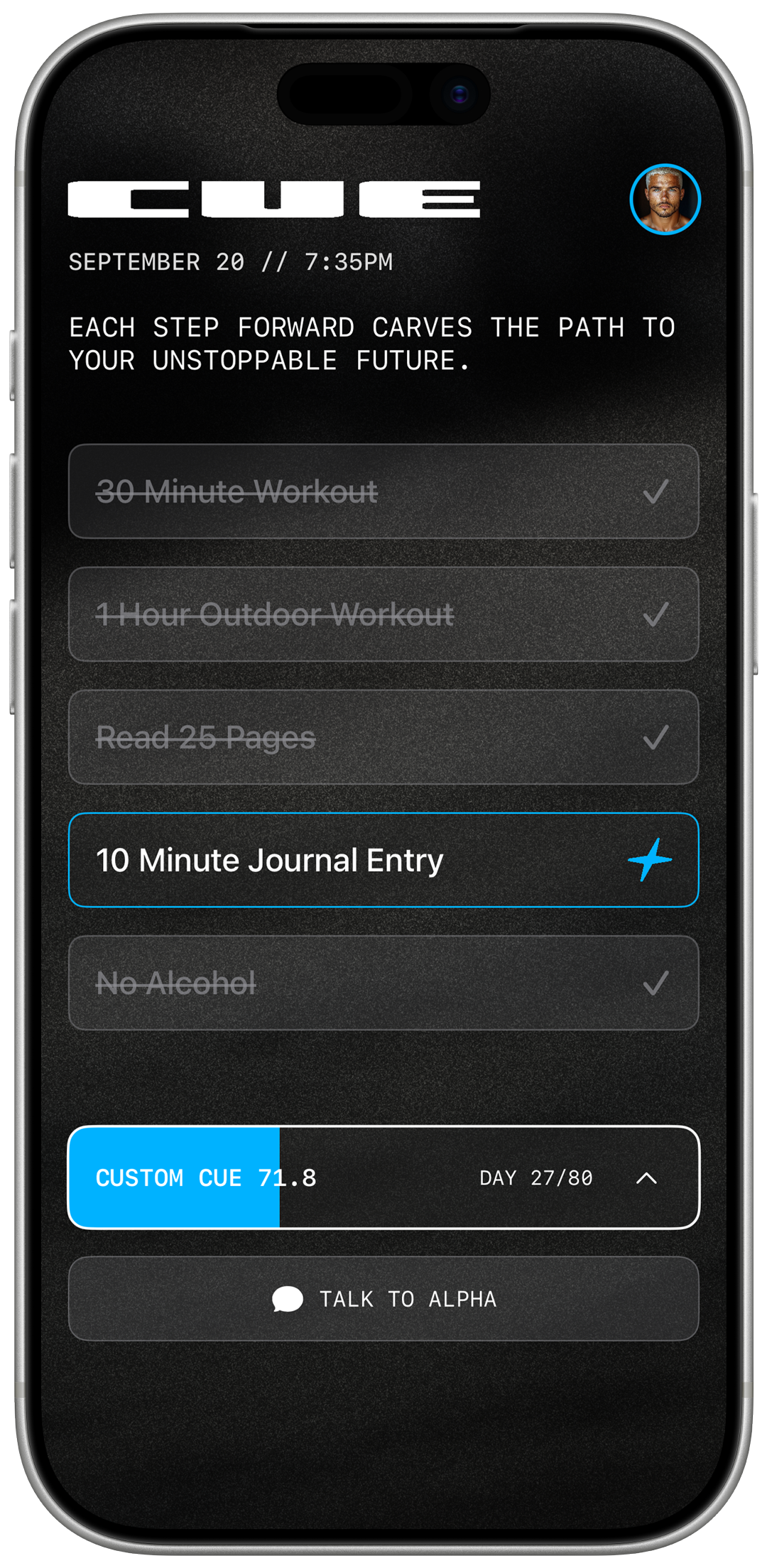
Cue is a commitment device. You don't track progress. You track completion.
You set a rule: no social media for 30 days. You commit to the challenge. Every day, you either complete it or you don't. Miss one day? You restart. Day 1 again.
This isn't punishment. It's accountability. The system doesn't care about your excuses. It cares about execution. That's how you build discipline — by proving to yourself that your word means something.
Most apps let you track streaks and feel good about yourself. Cue makes you earn the streak. There's no flexibility. No skip days. No adjusting the rules when it gets hard. You commit or you restart.
Step 4: Expect the Relapse
You're going to slip. Not because you're weak. Because breaking a deeply ingrained habit is hard.
The difference between people who break bad habits and people who don't isn't that they never fail. It's that they restart immediately.
You don't fail when you break the rule. You fail when you don't restart.
In Cue, this is built into the system. You break the rule? You restart. No shame. No spiral. Just back to day 1. That's the contract.
Step 5: Increase the Friction
Make the bad habit harder to do. Not impossible. Just inconvenient.
Delete social media apps from your phone. Put junk food in a hard-to-reach place. Set up your environment so the default action is the good habit, not the bad one.
You're not relying on willpower. You're designing your life so willpower isn't necessary. The path of least resistance becomes the right path.
The 30-Day Threshold
Most people give up after three days. They feel uncomfortable and assume it's not working.
The discomfort is the point. Your brain is resisting the change. It wants the easy dopamine hit. It wants the escape. That resistance is a sign you're doing it right.
Commit to 30 days. Not "see how it goes." Not "try it out." Full commitment. 30 days of zero tolerance.
By day 10, the urges weaken. By day 20, the new behavior starts to feel normal. By day 30, you've proven you can do it. That proof is what builds confidence.
Why "Cutting Back" Doesn't Work
You can't moderate a bad habit. You can only eliminate it.
"I'll just check social media once a day" becomes twice, then five times, then you're back where you started. "I'll just have one drink" becomes three. The brain doesn't do moderation well. It does patterns.
If the habit is bad, kill it. Replace it with something better. Don't try to control it. Control is exhausting. Elimination is final.
The Identity Shift
Breaking a bad habit isn't about behavior change. It's about identity change.
You don't want to be someone who "tries not to scroll." You want to be someone who doesn't scroll. You don't want to be someone who "avoids junk food." You want to be someone who eats clean.
That shift happens through repetition. Every day you honor the rule, you reinforce the new identity. You're not struggling to quit. You're becoming someone who doesn't do that anymore.
Breaking Multiple Habits
Don't try to break five habits at once. Pick one. The most damaging one. The one that's stealing the most time, energy, or focus.
Break that one completely. 30 days. Then move to the next.
Trying to fix everything at once overwhelms your system. You spread your discipline too thin. Then when you fail at one, you fail at all of them.
One habit. Full commitment. Complete elimination. Then the next.
What Happens After 30 Days
After 30 days, you'll notice something: you don't miss the habit. You thought you would. You thought it would be unbearable. But the craving faded. The urge disappeared.
What you gain is bigger than what you gave up. Time. Focus. Energy. Self-respect.
Breaking a bad habit isn't about deprivation. It's about replacement. You're not losing something. You're gaining control.
Your Next 30 Days
Pick the habit. The one you know is holding you back.
Define the rule. Binary. No negotiation.
Lock it into Cue. 30 days. Complete it or restart.
Don't ease out. Don't cut back. Eliminate.
You already know what needs to go. Stop negotiating. Start executing.